Author: admin

  • The Resurgence of Antibody Drug Conjugates: How ADCs are taking over oncology (again) and what we’ve learned about creating bioanalytical methods to support preclinical and clinical success.

    Michelle Miller, PhD, Global Senior Scientific Director, Bioanalytical Services

    What is an ADC?

    Antibody Drug Conjugates (ADCs) consist of a monoclonal antibody linked to a cytotoxic payload. The antibody binds to a cancer antigen, resulting in the targeted delivery of the payload to the tumor site. This potent approach to immunotherapy is often referred to as a “magic bullet” and has become a highly successful approach in oncology. Key aspects of ADC design include the stability of the linker (stable versus cleavable) and the amount of drug per antibody (Drug-Antibody Ratio or DAR) in addition to the antibody specificity for the antigen of interest.

    A Brief History of ADC Therapeutics:

    ADCs have had a long, tenuous journey over the last forty years. The first generation of ADCs reached the clinical trial stage in the 1980’s. These consisted mainly of murine antibodies and early variations were associated with high levels of off-target toxicity. It wasn’t until the year 2000 that the first ADC received FDA approval. Yet even this drug, Pfizer’s Mylotarg, had a problematic timeline, being withdrawn from the market in 2010 before re-approval in 2017.

    In the last decade, cell therapies have been the new modality leading the way in the immunotherapy space but after a number of serious setbacks and significant manufacturing challenges for cell therapy products, ADCs began to return to the spotlight. Drug developers have continued to improve upon ADC design with better linker technologies, modified antibody structures, and an expanded selection of payload molecules contributing to more advanced ADC drug candidates.

    In 2021 alone, 11 ADCs received approval from the FDA and there are currently an estimated 200 new ADCs in clinical trials. The global market for ADCs has grown dramatically and is projected to reach $32.11 billion USD by 2033.

    Bioanalytical Testing Strategies for ADCs:

    Testing of investigational ADCs in clinical studies requires specific solutions for several unique challenges. In addition to the clinical concerns associated with narrow therapeutic windows and low tumor penetration, the bioanalytical strategy for clinical sample analysis of ADCs requires careful planning. In particular, the multidomain structure and the stability of the conjugated components can lead to complex pharmacokinetic measurements and necessitate strategic approaches to immunogenicity method development.

    To overcome dose-limiting toxicities from premature payload release, the stability or target-specific cleavability of the linker is a major consideration in ADC design. Understanding the timing, efficiency, and location of linker cleavage is therefore a critical aspect of characterizing the drug absorption, distribution, metabolism, and excretion (ADME) profile. Distinct PK methods must be designed to detect the different forms of the drug including conjugated (antibody+linker+drug) and unconjugated (antibody or drug alone) variations. Multiple assays can be used together to form the full picture.

    Common bioanalytical strategies include:

    Total Antibody – ligand binding assay; quantitates the antibody component of the ADC with reagents designed to capture/detect conjugated, partially unconjugated, or fully unconjugated forms
    Conjugated Antibody – ligand binding assay; quantitates antibody with at least one linker-drug component, can be designed to be DAR specific if appropriate reagents are available
    Unconjugated Drug – LC-MS; small molecule drug/payload not conjugated to the antibody
    Total Drug – LC-MS; incorporates a sample digestion to quantitate both unconjugated and conjugated drug
    Anti-drug antibody (ADA) methods to monitor humoral immune responses against the ADC are a required part of bioanalytical testing. For most ADA assays, a bridging format is preferred which uses plate-bound ADC to capture any ADAs from patient samples and digoxin or ruthenium-labeled ADC to detect the bound ADAs. In this approach, antibodies directed against any of the three regions of the therapeutic can be detected in a single method. However, the multidomain structure of ADCs may necessitate additional characterization of ADA responses to better understand the immunogenic potential of each part separately.

    Positive controls for these assays are a critical reagent used to demonstrate assay sensitivity, specificity, and precision during ADA assay development. The most common type of positive control is an anti-idiotypic antibody which targets the variable region of the drug antibody. However, if domain characterization studies are part of the immunogenicity strategy, additional antibodies that specifically bind to the payload and linker regions are required.

    The Difference Experience Makes:

    ADCs are a powerful tool in cancer therapy, combining the specificity of monoclonal antibodies with the potency of cytotoxic small molecules. The complex and heterogenic nature of these modalities requires specialized understanding and careful planning to ensure the appropriate solutions are in place for successful PK and immunogenicity measurements in support of clinical testing.

    At Celerion, we have deep expertise in designing and implementing phase- and modality-appropriate PK and immunogenicity bioanalytical strategies. With over 50 years of experience in method development, validation, and sample analysis, our scientific teams provide unparalleled bioanalytical support across the pharmaceutical and biotech industries. Our GLP, GCP/GCLP, CLIA/CAP certified laboratories are equipped with state-of-the-art equipment and offer a full suite of bioanalytical services including LC-MS, MSD, and ELISA methods for ADC testing.
  • Celerion Welcomes Dr. Steven Evans as Senior Cardiologist to Enhance Cardiovascular Safety in Clinical Trials

    LINCOLN, Neb.; Nov. 20, 2025 (Business Wire)Celerion, a global leader in early-stage clinical research, announced the appointment of Dr. Steven Evans as Senior Cardiologist. In his new role, Dr. Evans will strengthen the company’s commitment to participant safety and data integrity by providing expert cardiovascular oversight.

    Dr. Evans’ responsibilities will be central to Celerion’s clinical trial operations. He will perform detailed ECG and Holter review and analysis, adhering to strict protocols. He will also serve as a key consultant to the Principal Investigator team to monitor the safety of participants enrolled in clinical trials and serve as an educational resource on cardiovascular matters. His functions are integral to upholding Celerion’s reputation as an industry leader in early-phase studies.

    His responsibilities include providing consultative services for safety ECG reviews, analyzing continuous digital Holter recordings for potential dysrhythmia, and promptly alerting investigators to any serious adverse clinical events identified in cardiovascular data. These critical tasks directly support patient safety and preserve the high-quality data Celerion is known for.

    Dr. Evans joins Celerion with extensive experience in cardiac electrophysiology. He completed his fellowship at Cedars-Sinai Medical Center, established the EP program at Long Island Jewish Hospital, and later continued his clinical and research work at Beth Israel Medical Center. He has also consulted for top medical device companies such as Johnson & Johnson, Boston Scientific, Medtronic, and currently serves as Consultant Medical Director for Orchestra Biomed.

    “We are delighted to welcome Dr. Evans to the Celerion team,” said Phil Bach, Celerion’s Executive Vice President of Global Clinical Research. “His extensive expertise in cardiac electrophysiology and his proven track record in both clinical practice and research will be invaluable. We are confident that his contributions will significantly enhance our cardiovascular safety capabilities and reinforce our mission to help our clients get their products to market faster.”

    About Celerion

    Celerion, a global leader in early clinical research, offers clients expert-driven services that enable fast, informed decisions in drug development. With over 50 years of experience, Celerion specializes in Phase 1 studies, including first-in-human dose escalation, drug-drug interactions, cardiac safety, bioequivalence, metabolism, and pharmacokinetics in patient populations. Celerion also provides comprehensive data management, biostatistics, clinical monitoring, and bioanalytical services. For more information, visit www.celerion.com

  • Celerion Earns AAHRPP Full Reaccreditation for Five Years, Strengthening Commitment to Ethical Research Practices

    LINCOLN, Neb.; Oct 9, 2025 (Business Wire) – Celerion, a leader in early clinical research, proudly announces its achievement of a full AAHRPP (Association for the Accreditation of Human Research Protection Programs) reaccreditation for five years by the Council on Accreditation of AAHRPP. Celerion is the only CRO headquartered in the USA to hold this distinguished accreditation. This prestigious recognition underscores Celerion’s unwavering dedication to maintaining the highest ethical standards, safeguarding participant welfare, and fostering excellence in clinical research.

    AAHRPP accreditation is a coveted distinction in the research industry, signifying that an organization upholds rigorous standards for human research protection. By achieving this reaccreditation, Celerion strengthens its position as an industry leader and its ongoing commitment to advancing groundbreaking clinical studies in a safe and ethical manner.

    “This milestone represents the hard work and dedication of our entire team,” said Phil Bach, Celerion’s Executive Vice President of Global Clinical Research. “We are deeply committed to upholding participant safety and the highest ethical standards in our research. Earning AAHRPP reaccreditation for five years reflects our steadfast focus on setting the benchmark for clinical research excellence and integrity. We are honored to receive this recognition and remain focused on making meaningful contributions to the field of clinical development.”

    The AAHRPP accreditation process is rigorous, requiring a comprehensive evaluation of an organization’s policies, practices, and commitment to continuous improvement in human research protection. This achievement reinforces Celerion’s capability to manage complex clinical programs while prioritizing the well-being of participants—an essential element of ethical research practices.

    With over 50 years of experience in clinical research, Celerion has earned a global reputation for innovation and leadership. This reaccreditation not only validates the company’s dedication to regulatory compliance but also sets it apart as a trusted partner for sponsors seeking to conduct high-quality research.

    About Celerion

    Celerion, a global leader in early clinical research, offers clients expert-driven services that enable fast, informed decisions in drug development. With over 50 years of experience, Celerion specializes in Phase 1 studies, including first-in-human dose

    escalation, drug-drug interactions, cardiac safety, bioequivalence, metabolism, and pharmacokinetics in patient populations. Celerion also provides comprehensive data management, biostatistics, clinical monitoring, and bioanalytical services. For more information, visit www.celerion.com.

  • PBMCs or Whole Blood? Strategic Applications in Phase I Studies

    Studying peripheral blood mononuclear cells (PBMCs) reveals cell-specific biomarkers—like target engagement and receptor occupancy—that improve decision-making in Phase I clinical trials. This makes these assays incredibly powerful tools in early-phase studies and has resulted in a growing trend of incorporating PBMC isolation and flow cytometry in Phase I clinical studies.

    PBMCs are a group of white blood cells with a single nucleus, separated from whole blood through centrifugation. They include monocytes, lymphocytes, dendritic cells, T cells, B cells, and natural killer cells.

    In this blog article, we’ll compare PBMCs and whole blood sample types and review their strategic applications in Phase I trials. We’ll also show how Celerion’s expertise in PBMC isolation and flow cytometry can accelerate your clinical program.

    What Is Flow Cytometry?

    Flow cytometry is a technique that measures cells in suspension. The cells are tagged with a fluorescent molecule that absorbs light at a specific wavelength and re-emits light at a longer wavelength. This can be leveraged to ‘gate’ or sort a specific cell population.

    Why Choose PBMCs Over Whole Blood in Phase I Assays?

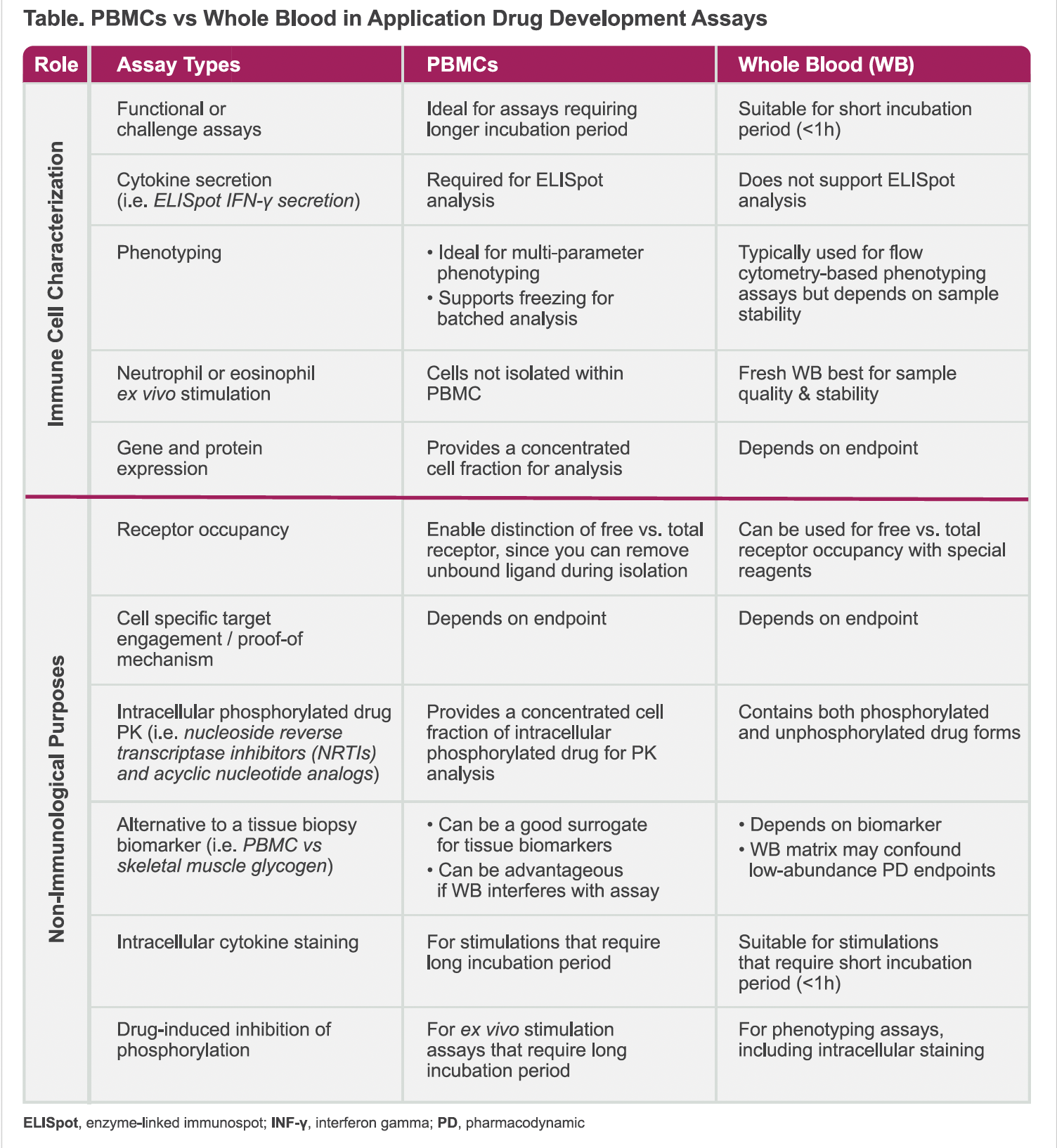
    Whole blood contains red blood cells, PBMCs, platelets as well as hormones, lipids, proteins. While whole blood requires little initial sample handling compared to the PMBC isolation process. PBMC isolation can be advantageous, supporting several downstream analyses, such as ELISpot. In addition, the whole blood components may interfere with the assay and hinder stimulation or incubation of cells with targeted reagents, therefore PBMC isolation and appropriate cell culture environment are preferred.

    Table. PBMCs vs Whole Blood in Application Drug Development Assays

    Innovative Approaches to Clinical Pharmacology

    Beyond immune characterization, PBMCs offer novel opportunities in clinical pharmacology. PBMC isolation and flow cytometry has traditionally been applied for immune cell characterization and biologics, however this procedure can also be leveraged for small molecules and for non-immunological purposes. In particular, PBMC isolation can support clinical pharmacology studies, for example:

    • Deeper Insights: PBMCs can provide deeper insights into cell-specific target engagement and intracellular drug activity, enhancing the understanding of drug mechanisms and effects.
    • Less Invasive Alternatives: PBMCs can potentially replace invasive procedures, such as skeletal muscle biopsies, by serving as surrogate biomarkers for tracking drug effects and activity.
    • Versatility: PBMCs can be leveraged for small molecules and non-immunological purposes in addition to biologic drug development, expanding their applicability in various clinical pharmacology studies.

    Our PBMCs Experts are Ready to Support your Next Study

    These approaches and their strategic applications were discussed early this year with industry peers at the ASCPT 2025 conference in Washington, DC, highlighting the growing role of PBMC-based assays in accelerating early-phase drug development.

    Celerion has experience with incorporating PBMCs into a variety of clinical pharmacology studies including SAD/MAD, bioavailability, food effect, drug-drug interaction (DDI) and renal/hepatic impairment, as well as bioanalytical support for late phase studies. At Celerion, our expert clinical pharmacology & bioanalytical team can help unlock your next study by gaining deeper insights with PBMC & flow cytometry technology.

  • The Rising Tide of Weight Reduction Therapies

    Sabina Paglialunga, PhD Senior Director, Scientific Affairs

    Weight reduction drugs are making a big splash! Since glucagon-like peptide 1 (GLP-1) receptor agonists were first approved for weight loss in 2021, there has been an estimated 700% increase in prescriptions in the US.1  This has led to a wave of new GLP-1 and incretin products entering into clinical research.  Currently, there are nearly 150 novel GLP-1 receptor agonists in various stages of drug development globally.2 Beyond GLP-1, there are several other targets being explored for weight loss, also eager to swim in the same waters. In response, the Food and Drug Administration (FDA) recently updated guidance for industry to support drug development: Obesity and Overweight: Developing Drugs and Biological Products for Weight Reduction

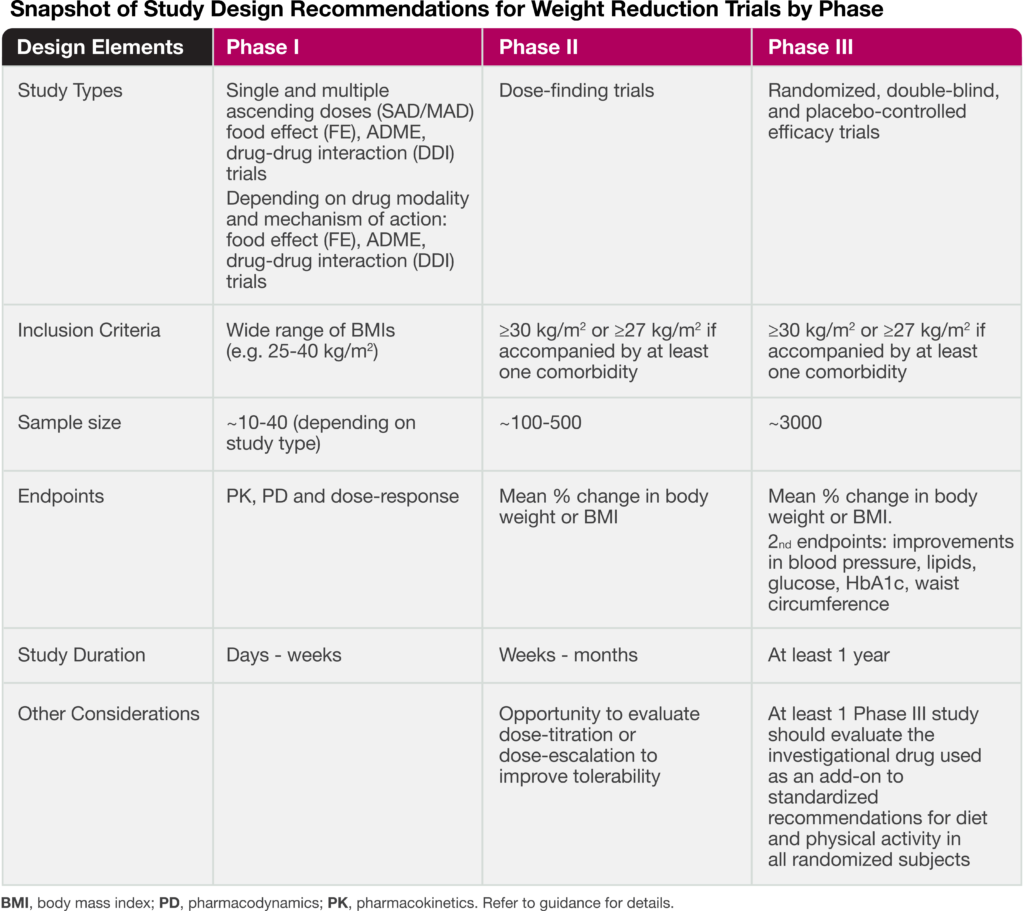
    The guidance addresses key aspects for drug developers, including recommendations for early and late phase trials, as well as input on sample size and primary endpoints. The following table highlights important study design elements.

    As recently discussed in our blog article: Reframing the Definition of Obesity, the draft guidance also places emphasis on utilizing body mass index (BMI) for inclusion/exclusion criteria as well as the percent change in BMI for a primary endpoint.  The FDA recognizes that while BMI is not a direct measure of adiposity (fat mass), it is a simple and effective assessment in which at least a 5% reduction is generally associated with improvement in metabolic and cardiovascular risk factors. In addition, to ensure the weight reduction effect is not due to loss of lean-body mass, body composition assessment by dual x-ray absorptiometry (DEXA) or another imaging modality is highly advised.

    Safety Assessments for Weight Reduction Drugs

    In terms of safety assessments, the FDA recommends monitoring changes in blood pressure and lipids. Early phase studies, such as SAD/MAD, also provide an opportunity to assess proarrhythmic risk (i.e., QTc prolongation), as well as immunogenicity potential for biologic therapies, including peptide drugs. The guidance also recommends including C-SSRS questionnaires for centrally acting drugs and echocardiographs for serotonin inhibitors.

    Combination Products

    Common adverse events associated with current GLP-1 therapies include nausea, vomiting, and muscle mass loss. To that end, an emerging trend is to optimize weight loss and minimize potential side effects with combination products.  The guidance recommends assessing the safety and PK of each component in Phase I studies prior to initiating late-stage fixed-combination drug products trials.

    Diving into Celerion’s Weight Reduction Experience

    Celerion has extensive experience with a wide range of compounds for weight reduction, including GLP-1 receptor agonists, insulin sensitizers, and microbiota products. Our comprehensive experience with anti-obesity drugs covers all aspects of development; from first-in-human studies and proof-of-concept trials to clinical pharmacology studies to support labeling, such as drug-drug interaction – and bioavailability/bioequivalence studies.

    Conclusion

    As research in this indication continues, one can anticipate that the next generation of weight reduction therapies will render better safety profiles, more convenient drug administration (e.g., oral products or less frequent subcutaneous dosing), and improved patient adherence.  Celerion is ready to help navigate the regulatory waters and support drug developers by leveraging our early phase clinical research experience, expertise, and efficiencies for smooth sailing ahead!

    References

    1. Gratzl, S et al. Monitoring Report: GLP-1 RA Prescribing Trends – June 2024 Data. medRxiv 2024.01.18.24301500; doi: https://doi.org/10.1101/2024.01.18.24301500
    2. GlobalData search,14-Feb-2025.

  • Celerion Launches Enhanced Version of Labnotes Bioanalytical Data Management Software 

    LINCOLN, Neb.; May 6, 2025 (Business Wire) – Celerion, a global leader in early clinical research and bioanalytical services, announced the launch of the latest version of Labnotes, its cutting-edge bioanalytical electronic laboratory notebook software, elevating data handling and analysis capabilities for sponsors. 

    The latest system enhancements streamline laboratory documentation and improve operational efficiency for users. The updated platform also offers advanced tools for handling and organizing large datasets, ensuring faster processing of reports and optimized database queries. 

    “With this enhanced version, Celerion underscores its commitment to expanding the use of cutting-edge technology to support its clients in achieving business success,” said Chad Briscoe, Executive Vice President of Global Bioanalytical Services at Celerion. “These improvements demonstrate our continued commitment to innovation and excellence in all facets of our laboratory operations.” 

    Celerion also introduced robust features to support security and flexibility. Enhanced encryption and secure access controls guarantee data protection, while new archiving and extraction tools enable secure data sharing without requiring the core software. Additionally, the inclusion of a Report API allows seamless integration with external reporting tools, providing users with tailored reporting capabilities to meet their specific needs. 

    “Our approach to software development is rooted in customer feedback and the latest industry trends. The updates in Labnotes empower clients with robust tools to manage and analyze their data effectively, enabling better decision-making and driving impactful business outcomes, said Mark Williams, CEO of Terrington Data Management. 

    About Celerion 

    Celerion, a global leader in early clinical research, offers clients expert-driven services that enable fast, informed decisions in drug development. With over 50 years of experience, Celerion specializes in Phase 1 studies, including first-in-human dose escalation, drug-drug interactions, cardiac safety, bioequivalence, metabolism, and pharmacokinetics in patient populations. Celerion also provides comprehensive data management, biostatistics, clinical monitoring, and bioanalytical services. For more information, visit www.celerion.com

    About Terrington Data Management 

    Terrington Data Management provides specialist software solutions to a variety of international customers, including clients within Oil, Gas, Pharmaceutical, Chemical and Manufacturing Sectors. The company’s software is designed to securely store, collect and utilize business information in order to improve overall business workflow. 

    Labsform, DocMan and OPAL were developed to meet the requirements of laboratory scientists working in tightly regulated bioanalytical laboratories to enhance productivity, streamline workflows and improve compliance. The software has since been used in laboratories across the world serving a variety of disciplines from R & D to clinical management. For more information, visit www.labsform.com

  • Rethinking Drug Development: The Role of Model-Informed Approaches in Advancing Cell and Gene Therapies Without Animal Testing

    By Johannes Stanta, PhD, Global Scientific Director, Celerion Inc.

    As drug development continues to evolve, few areas are advancing as disruptively as cell and gene therapies (CGTs). These highly complex and often personalized treatments are redefining what is possible in modern medicine. But while the science has leapt forward, many of the tools and assumptions behind therapeutic development have not. In particular, our continued reliance on animal models is becoming an increasingly obvious limitation.

    That is where Model-Informed Drug Development (MIDD) comes in, and why now is the time to reexamine how we generate, interpret, and act on data throughout the development process.

    Why Animal Models Fall Short for CGTs

    CGTs operate through fundamentally different mechanisms than small molecules and biologics. Many of these therapies are intended for one-time administration, with long-lasting effects driven by genome editing, transgene expression, or cellular persistence. They do not follow classical dose-response relationships, do not exhibit linear clearance, and often behave in ways that are highly patient-specific and immune-mediated.

    Despite this, drug developers and regulators continue to apply drug development frameworks designed for small molecules, relying on assumptions about repeated dosing, systemic pharmacokinetics, and linear modelling. This disconnect between therapeutic modality and development model often results in inefficiencies, suboptimal trial designs, and an overreliance on animal models that offer limited predictive value. Some regulatory agencies are beginning to acknowledge this gap. The FDA Modernization Act 2.0 and the agency’s 2024 roadmap to reduce animal testing both signal a shift toward more human-relevant, model-based approaches.

    The Role of MIDD in CGT Development

    MIDD integrates quantitative modelling, simulation, and data-driven decision-making across the product lifecycle. In the context of CGTs, this includes modelling the expansion, contraction, and persistence of engineered cells, predicting vector biodistribution across human tissues using physiologically based pharmacokinetic (PBPK) models, and understanding complex interactions between the therapy, disease pathways, and host immune responses through Quantitative Systems Pharmacology (QSP).

    These tools make it possible to simulate hypothetical scenarios, define safe and effective first-in-human doses, and design more informative early-phase trials …well before administering a dose to a volunteer. As a result, MIDD reduces risk, improve administration of effective doses and decreases dependence on translation of animal-based safety and efficacy studies.

    Bioanalysis: The Unsung Hero

    Models are only as good as the data that inform them. Bioanalysis plays a crucial role in enabling model-informed development. Whether measuring vector DNA by PCR, quantifying cell expansion through flow cytometry, or assessing an expressed protein via ligand-binding assays, high-quality bioanalytical data are the foundation of any meaningful model.

    Advanced bioanalytical platforms such as LC-MS/MS, immunoassays, digital droplet PCR, spectral flow cytometry and in vitrofunctional assays are not merely supportive tools, they are essential for the development and application of MIDD. Moreover, these human-relevant technologies are central to the FDA’s strategy for reducing animal testing. In the development of CGTs, mechanism-based bioanalysis is no longer optional. It is a scientific and regulatory necessity.

    Looking Ahead: AI, NAMs, and a New Development Ecosystem

    MIDD does not exist in isolation. It is now embedded in a broader framework that includes artificial intelligence (AI), New Approach Methodologies (NAMs), and growing regulatory support for model-based submissions. AI and machine learning are already being used to identify pharmacodynamic endpoints, biomarkers, stratify patients, generate virtual populations, and simulate clinical outcomes. At the same time, NAMs (including organ-on-chip systems and in vitro immune models) are producing more human-relevant preclinical data than traditional animal models.

    When combined, these tools offer a smarter and more responsive way to develop CGTs. They support a more predictive understanding of efficacy and safety, reduce dependence on animal models that are often poorly translatable, and improve development timelines by avoiding lengthy and costly primate studies that yield limited actionable insights. In vitro methods can generate targeted, mechanistic data that feed directly into model frameworks, making them not only faster and more cost-effective but also better suited to the biology of CGTs.

    Yet, development budgets are still heavily weighted toward animal testing, not because it delivers superior science, but because it remains deeply embedded in the regulatory process. As MIDD and NAMs continue to mature and regulatory standards emerge, this logic will be reversed. The focus will shift to the tools that provide the most decision-relevant, human-specific data.

    The MIDD-driven ecosystem is also inherently more compatible with personalized medicine. CGTs are frequently developed for narrow patient populations or even individual patients. Traditional animal models are not equipped to handle this level of variability, whereas MIDD allows developers to model population-level and individual responses with far greater precision.

    Final Thoughts

    As someone working at the intersection of CGTs, bioanalysis, and model-based development, I have seen firsthand how these approaches are converging—and how rapidly expectations are changing across the industry. What was once aspirational is now an operational reality.

    If we want to unlock the full potential of CGTs, we must move beyond legacy frameworks. MIDD, informed by robust analytics and bioanalytical data, offers a clearer, more efficient, and more ethical path forward. This is not only better science—it is better drug development.

    If you are asking similar questions or actively working to reduce reliance on animal models through smarter, model-based development strategies, we would love to connect.

  • Smarter, Faster, Safer: Celerion Unveils Major Upgrade to LabNotes Bioanalytical Software

    At Celerion, we believe that innovation in the lab shouldn’t come at the cost of simplicity or security. That’s why we’re excited to announce the latest evolution of LabNotes, our bioanalytical electronic laboratory notebook (ELN) software designed to make data management more intuitive and more powerful than ever before.

    Whether you’re managing massive datasets or juggling multiple timelines, the newest version of LabNotes was built with one goal in mind: to help our clients move faster, think smarter, and protect their data with confidence.

    What’s New in LabNotes?

    The upgraded platform brings a host of improvements focused on speed, scalability, and security:

    • Streamlined Laboratory Documentation – Simplified workflows reduce documentation time and improve day-to-day efficiency.
    • Enhanced Dataset Management – Advanced tools make it easier to organize, analyze, and report on large data sets.
    • Improved Query Optimization – Faster, more reliable database access to keep projects moving forward without delays.
    • Advanced Security Features – With upgraded encryption and access controls, data protection is built into every layer.
    • Flexible Data Sharing – New archiving and extraction features make it easy to share information securely—without needing to install or run the core software.
    • Custom Report Integration – A newly added Report API allows teams to connect with third-party reporting tools for fully tailored data outputs.

    Built for the Way You Work

    “With this enhanced version, Celerion underscores its commitment to expanding the use of cutting-edge technology to support its clients in achieving business success.,” says Chad Briscoe, Executive Vice President of Global Bioanalytical Services at Celerion.“ These improvements demonstrate our continued commitment to innovation and excellence in all facets of our laboratory operations.”

    “Our approach to software development is rooted in customer feedback and the latest industry trends. The updates in LabNotes empower clients with robust tools to manage and analyze their data effectively, enabling better decision-making and driving impactful business outcomes”, says Mark Williams, CEO of Terrington Data Management

  • FDA Endorses Human-Relevant Nonclinical Models: A Welcome Shift for Monoclonal Antibody Development

    by Johannes Stanta, PhD – Global Scientific Director, Sabina Paglialunga, PhD – Senior Scientific Director, and Aernout Van Haarst, PhD – Senior Scientific Director

    The FDA’s recent decision to support non-animal methods for the safety evaluation of monoclonal antibodies (mAbs) is a significant—and long overdue—step forward in modernizing drug development. While the scientific community has long embraced the 3Rs framework (Refine, Reduce, Replace), regulatory acceptance has historically lagged behind. This has limited the practical application of advanced non-animal technologies beyond academic discovery and internal candidate selection.

    Until now, animal testing has remained a regulatory default—often considered mandatory—with little room for alternative strategies. Good Laboratory Practice (GLP) enforcement has added further rigidity, making it challenging to integrate more flexible, human-relevant tools into regulated programs.

    A Question of Translation, Not Tradition

    The limitations of animal models are well established. Across therapeutic areas, particularly in immunology and oncology, the predictive value of animal studies for human outcomes is poor. In the context of mAbs, these limitations are especially pronounced. Safety signals often arise from excessive pharmacologic action or immune activation, rather than classical dose-dependent, off-target toxicity. These mechanisms are difficult—if not impossible—to model in animals, where interspecies differences in immune architecture obscure translatability.

    This regulatory shift now enables the broader use of validated New Approach Methodologies (NAMs)—including organoid models, immune microphysiological systems, and in silico tools—as part of safety packages for investigational new drug (IND) applications. Notably, the FDA will also begin accepting real-world human safety data from other regulatory jurisdictions, providing an opportunity to reduce duplicative and ethically questionable animal studies.

    Opportunities and Challenges for the Field

    This shift raises important questions for the drug development ecosystem:

    • Can NAMs provide sufficient data to inform a safe starting dose for a first-in-human study? The current mAb paradigm relies on minimal anticipated biological effect level (MABEL) or physiologically active dose (PAD) to establish a first starting dose. While the MABEL approach can be fulfilled without animal testing as it often includes in vitro receptor occupancy assessments, the PAD approach tends to comprise of animal models, which may require rethinking or development of newer methodologies to substantiate a non-animal model.       
    • How do we build confidence in the performance of NAMs? While early data on systems like liver chips and cytokine release assays are promising, widespread adoption will require validation, reproducibility, and clearly defined regulatory contexts of use.
    • Are current laboratory infrastructures ready to support the complexity of these models? Organoids and microphysiological systems demand expertise in cell biology, tissue engineering, and real-time functional readouts. Integrating such technologies into a GLP-aligned environment is a non-trivial task, especially as these concepts have often been deployed in non-GLP discovery or academic settings.
    • What frameworks are needed to standardize these methods across sponsors and regulators? Without harmonized protocols, the interpretation of NAM-based safety data risks inconsistency, delaying regulatory confidence.
    • How will bioanalytical and pharmacokinetic modeling capabilities evolve to complement these in vitro systems? Tools like physiology-based pharmacokinetic (PBPK) modeling, quantitative systems pharmacology (QSP), and immunogenicity prediction will need to be deeply integrated into the workflow and accelerated using machine learning approaches to continuously improve outcomes and applicability.
    • What type of research organizations will be best equipped to navigate this transition? It is reasonable to envision that GLP-accredited laboratories combining molecular and cellular assay expertise, regulatory bioanalysis and tight integration with clinical trial units may be best positioned to bridge nonclinical insights and clinical execution.

    A Critical Inflection Point

    The field has been scientifically prepared for this transition for years. Now, with regulatory momentum finally aligning, the challenge is operational. The focus must turn to building capacity, ensuring reproducibility, and developing harmonized protocols while educating regulators to work with these tools effectively.

    This move by the FDA is not just a policy update—it is a call to action. If implemented thoughtfully, it will accelerate development timelines, reduce costs, uphold ethical standards, and, most importantly, improve the relevance of preclinical data to human biology.

    The burden now shifts to the industry to answer:
    Are we ready to let go of legacy models and build a nonclinical paradigm that truly reflects human physiology?

  • Ruling the Future: How the ACLA’s LDT Court Victory and Europe’s IVDR Are Shaping Bioanalytical Laboratories

    by Chad Briscoe, Executive Vice President, Global Bioanalytical Services, Celerion

    Someone whom I’ve worked with in the past and have had an opportunity to mentor in the bioanalytical field for some time recently asked me about the U.S. federal court ruling on LDTs. I realized I don’t really understand it as well as I would like to or as well as I should, and that I hadn’t been as “up-to-speed” on the current status of LDTs as used in the US or Europe. I decided to dig in and pull together a blog to help me learn and also help provide a guide for others that may want something that summarizes the current situation as I understand it.

    In a landmark legal decision announced by the ACLA (American Clinical Laboratory Association) on March 31, a U.S. federal court vacated the FDA’s attempt to regulate Laboratory Developed Tests (LDTs) as medical devices. This preserved the long-standing CLIA oversight. Essentially preserving the status quo.

    Meanwhile, across the Atlantic, the European Union’s In Vitro Diagnostic Regulation (IVDR) has been tightening control over diagnostic innovation. These two contrasting regulatory directions are reshaping the landscape for clinical and bioanalytical laboratories. Here’s my interpretation of what it means, why it matters, and how labs (in particular bioanalytical labs) can stay ahead.

    Laboratory-Developed Tests (LDTs) have become foundational to the rapid evolution of diagnostic science. In recent years, due to the increasing complexity of LDTs and the focus on biomarkers in traditional bioanalytical labs, this has become important to laboratories beyond just the traditional Clinical Laboratories, central laboratories, and local hospital labs. These custom assays—designed, manufactured, and used within a single or small number of laboratories—often address unmet clinical needs, are used to support clinical trials and new treatment options. These have become key tools in affordable precision medicine. However, their regulation has been in flux for over a decade, driven largely by activities in the United States and European Union.

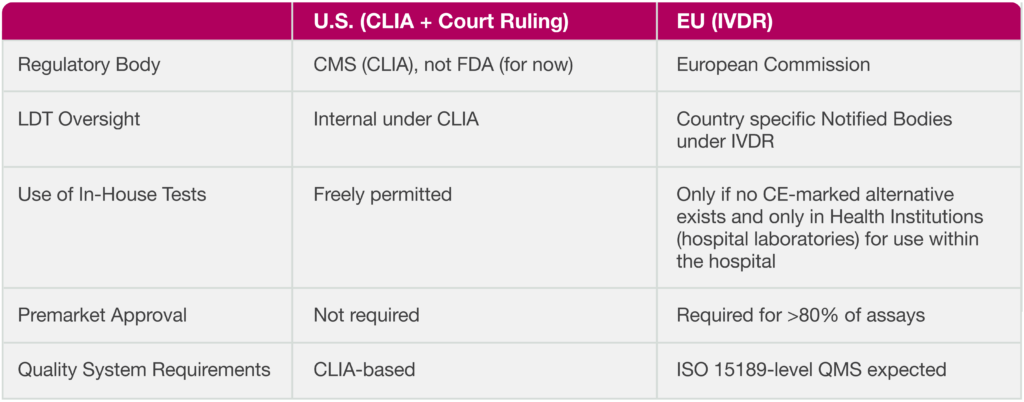
    In the U.S., a federal court recently vacated the FDA’s 2024 final rule that sought to classify LDTs as medical devices. This decision, brought forward by the American Clinical Laboratory Association (ACLA), reasserts CLIA (Clinical Laboratory Improvement Amendments) as the primary regulatory authority over LDTs. In Europe, however, the new In Vitro Diagnostic Regulation (IVDR) has taken the opposite approach, intensifying regulatory oversight and requiring an onerous approval process with extensive documentation, validation, and risk classification for all diagnostic tests—including in-house laboratory tests.

    Under the previous regulation, about 20% of laboratory tests were required to follow this path, but this has now increased to about 80% under IVDR.

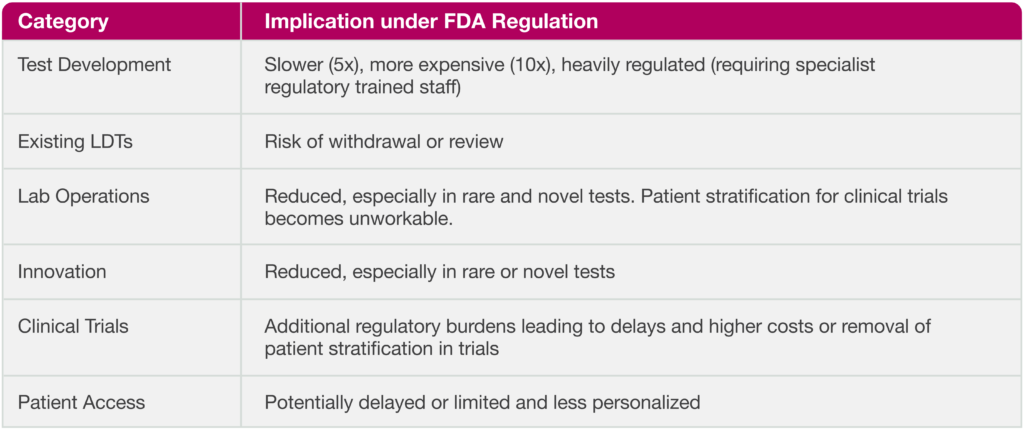
    Implications of FDA Regulating LDTs (If ACLA lawsuit had failed)

    The FDA’s now-overturned rule would have subjected LDTs to the same premarket review, labeling, and post-market surveillance required for commercial in vitro diagnostic devices, developed for a mass market. Critics, including ACLA and the Association for Molecular Pathology (AMP), argued that this overstepped statutory bounds, stifled innovation, and jeopardized access to critical diagnostics.

    The court’s ruling provides:

    • Regulatory Stability: Labs may continue operating under CLIA without additional FDA burdens.
    • Innovation Breathing Room: LDTs can still be developed and deployed quickly, often in response to urgent or rare clinical needs.
    • Continued Responsibility: While FDA oversight is paused, labs must continue to maintain rigorous internal validation practices and high-quality standards.

    For bioanalytical labs, this ruling helps sustain agile assay development, enabling continued support for clinical trials, specialty testing, patient stratification, patient enrollment, and companion diagnostics.

    The EU’s IVDR, which came fully into effect in May 2022, represents a complete overhaul of how diagnostics are regulated. Replacing the former IVDD, the IVDR imposes:

    • Risk-Based Classification (Class A to D) – though most LDTs are highly complex and therefore high risk
    • Performance Evaluation Requirements – requiring navigating a complex network of national Notified Bodies with varying interpretations of IVDR
    • Strict Use Conditions for In-House Tests – Typically, only hospital laboratories qualify when the test is used within the hospital.
    • Mandatory Quality Management Systems – ISO15189 is suggested, but accreditation bodies struggle to accredit non-routine clinical laboratories
    • Market Justification for Each In-House Test – requirement for regulatory review for each assay by a Notified Body

    In stark contrast to the U.S. model, the IVDR now requires labs to prove that no CE-marked equivalent exists before using an LDT. Labs must also implement formal procedures for ongoing safety, performance monitoring, and clinical evidence gathering.

    Key Differences at a Glance

    For labs operating in clinical trials, translational science, or patient diagnostics, these changes affect everything from compliance planning to assay design and budgeting.

    In the U.S.:

    • Labs retain operational flexibility.
    • No new device-level regulatory filings required.
    • Opportunity for rapid test iteration and clinical trial support.

    In the EU:

    • Labs face new regulatory hurdles.
    • In-house test development is resource-intensive.
    • There may be delays or discontinuation of certain novel assays due to compliance costs.
    • Patient stratification for clinical trials will be reduced or stopped unless absolutely necessary.

    Multinational labs performing LDTs must now manage dual compliance strategies:

    • In the U.S., keep internal systems CLIA-compliant while monitoring the policy landscape (e.g., VALID Act proposals).
    • In the EU, prepare for full IVDR implementation—especially if supporting EU-based clinical trials or patient testing.

    Labs performing cross-border testing (e.g., EU patients using U.S.-based services) will need to harmonize quality, documentation, and reporting standards to remain compliant with IVDR, even if physically located outside the EU. Laboratories outside the EU struggle to find the correct national Notified Body that will review and approve their IVD assay.

    The divergence between U.S. and EU regulation poses challenges—but also raises important questions:

    • Can future legislation, such as the VALID Act in the U.S., find a middle ground between oversight and innovation?
    • Will the EU refine or delay IVDR enforcement based on implementation feedback?
    • How can international standards be aligned to ease burdens for global labs?

    Industry advocacy groups like ACLA and AMP are already working toward legislative solutions, while European regulators are issuing guidance to clarify IVDR expectations. Collaboration across borders will be key to future success.

    Whether you’re a clinical lab director, regulatory affairs lead, or scientist in a bioanalytical CRO, the message is clear: the regulatory environment for diagnostics is evolving—rapidly and asymmetrically.

    In the U.S., the recent court decision protects flexibility and self-regulation—for now.

    In Europe, IVDR brings new rigor and central oversight—but also risks of reduced innovation.

    Globally, labs must adapt or risk falling behind.

    As science continues to evolve and offers the opportunity for personalized medicine, regulatory oversight shouldn’t stand in the way of enabling it; instead, it should find a way to accelerate the safe implementation. In our industry, public health regulations that enable advanced clinical trial designs and early patient access to innovative new medicines are just as critical as scientific advancement.

    Now is the time for bioanalytical labs to strengthen their quality systems, shake the fear of innovative solutions, and advocate for smart, science-driven oversight that puts patients first.