Author: admin

  • Reframing the Definition of Obesity

    Sabina Paglialunga, PhD Senior Director, Scientific Affairs

    Two notable guidance documents addressing obesity and weight loss were issued in January 2025. Surprisingly, they have differing opinions on the role body mass index (BMI) plays in the definition of obesity and the clinical management of patients with obesity.

    The two documents in question are:

    The recent FDA guidance defines obesity as a chronic disease characterized by excess adiposity and recommends using BMI, an anthropometric index, to classify weight groups. BMI is calculated as:  

    BMI = weight (kg) / [height (m)]2

    The formula has been around since the 1800’s. It was developed by Adolphe Quetelet, a Belgian statistician, mathematician, and astronomer, in 1832. However, it wasn’t validated as a measure of obesity until the 1970s by physiologist Ancel Keys (reviewed in Pray & Riskin). Now, BMI is commonly applied to assess health and stratify disease risk. BMI cutoff values are applied to classify overweight (25-29.9 kg/m2) and obesity class 1 (30-34.9 kg/m2), obesity class 2 (35-39.9 kg/m2) and extreme obesity (≥40 kg/m2).

    Weighing the Utility of BMI

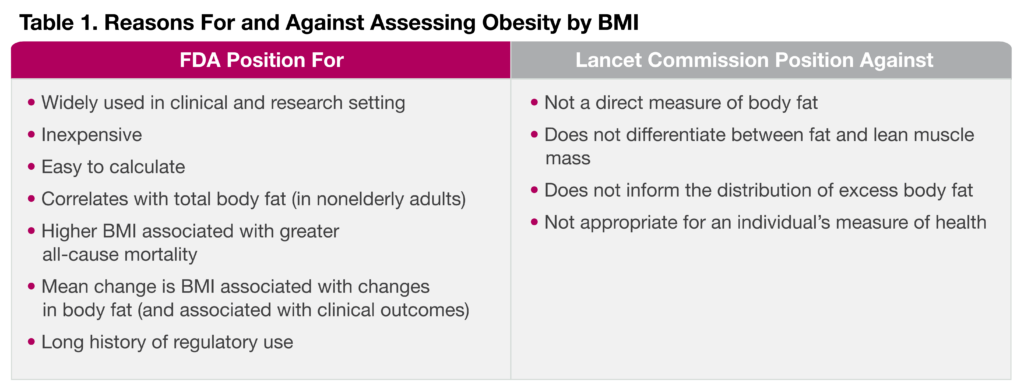
    While BMI is a convenient and long-standing measure to assess obesity, it does not differentiate between fat and lean muscle mass. It can either under- or over-estimate adiposity (fat mass). For example, older adults, conditions associated with bone or muscle mass loss, and certain ethnicities are prone to underestimation of obesity and fat mass by BMI, while conversely athletes could have overestimated obesity rates. Therefore, the Lancet Commission recommends that excess adiposity should be confirmed by either of the following as a second measure of fat mass, in addition to BMI: 

    • Waist circumference
    • Waist-to-hip ratio
    • Waist-to-height ratio
    • Bioimpedance
    • Direct measures of body fat such as dual X-ray absorptiometry (DEXA) or magnetic resonance imaging (MRI)

    One exception, however, is that clinicians may assume that a patient with a BMI ≥40 kg/m2 displays excess adiposity. The arguments to utilize or limit BMI in determining obesity are as follows.
    Redefining Obesity

    More poignant, the Lancet report also provides an updated and evidence-based definition of obesity, applying clinical and biological criteria for the diagnosis of this chronic illness.

    • Clinical obesity: a chronic, systemic illness characterized by alterations in the function of tissues, organs, the entire individual, or a combination thereof due to excess adiposity. Clinical obesity can lead to severe end-organ damage, causing life-altering and potentially life-threatening complications (e.g., heart attack, stroke, and renal failure).
    • Preclinical obesity: a state of excess adiposity with preserved function of other tissues and organs and a varying, but generally increased, risk of developing clinical obesity and several other non-communicable diseases (e.g., type 2 diabetes, cardiovascular disease, certain types of cancer, and mental disorders).

    The aim of reframing the definition of obesity and its assessment is to encourage more accessibility and effective management for those with an unmet need. Until recently, obesity alone, without the presence of other diseases, was not considered a disease in itself (reviewed in Rubino et al.).  This potentially led to negative implications for treatment options and insurance coverage for those with excess body fat without other comorbidities.  However, relying on BMI alone with these new definitions could lead to overdiagnosis of obesity, therefore direct excess fat assessment in addition to physical work-up is recommended.

    Conclusion

    While these two reports may seem at odds with each other, the Lancet Commission does concede that BMI should be used only as a surrogate measure of health risk at a population level, for epidemiological studies, or screening purposes. The latter is most notable for drug developers. Therefore, in line with the FDA guidance, BMI will continue to be the main inclusion criteria for weight loss clinical trials. However, additional markers of excess fat could provide better insight into drug effects on adiposity. To that end, Celerion has extensive experience with weight reduction drugs, including GLP-1 receptor agonists, insulin-sensitizing drugs, and microbiota products. We also offer a full range of adiposity assessments, including BMI, body weight, waist circumference, and bioimpedance, as well as sophisticated imaging assessments such as DEXA, MRI, and FibroScan® (liver fat content).

    Reference

    Pray R, Riskin S. The History and Faults of the Body Mass Index and Where to Look Next: A Literature Review. Cureus. 2023 Nov 3;15(11):e48230. DOI: 10.7759/cureus.48230

    Rubino F et al. Redefining obesity: advancing care for better lives. The Lancet Diabetes & Endocrinology. 2025 Jan 14;13(2):75. DOI: 10.1016/S2213-8587(25)00004-X

  • Celerion Expands UK Phase 1 Clinical Research Operations With New Agreement to Relocate to Queen’s University Belfast’s iREACH Health – Clinical Research Innovation Center 

    LINCOLN, Neb.; Feb. 19, 2025 (Business Wire) Celerion, a global leader in early clinical research, proudly announces a new agreement to relocate its U.K. Phase 1 clinical research operations to iREACH Health. This state-of-the-art clinical research center, led by Queen’s University Belfast, in partnership with the Belfast Health and Social Care Trust, is set to become a cornerstone of Northern Ireland’s life sciences innovation ecosystem upon its early 2027 completion. 

    Celerion’s Belfast clinic has a history of clinical research excellence spanning more than 30 years, marked by continual growth, expanding capabilities, and strong partnerships with academic and medical institutions. Relocating to iREACH Health positions Celerion at the forefront of clinical research innovation, facilitating collaboration across government, industry, and academia to advance novel therapies for patients in need. 

    iREACH Health will be situated across two buildings beside Belfast City Hospital. The clinical research innovation center will include a 100-bed Phase 1 facility designed to Celerion’s specifications, equipped to support its U.K. team, including a highly experienced full-service data management, medical writing, and biometrics group. This team of early development experts specializes in adaptive study design, protocol development, clinical data sciences, PK/PD analysis, and statistical reporting, delivering data-driven insights that reduce risk and optimize trial outcomes. 

    “We’re thrilled to build on our long-standing relationship with Queen’s University Belfast by relocating to this world-class center,” said Phil Bach, Celerion’s Executive Vice President of Global Clinical Research. “Our new home at iREACH Health will enhance the speed and efficiency of our Phase 1 clinical trials, supporting our clients in accelerating drug development timelines.” 

    Professor Judy Bradley, CEO of iREACH Health, highlighted the innovation center’s vision: “Our aim is to deliver agile, people-centered clinical trials that are innovative, data-driven, and digitally enabled. We are delighted to work with Celerion to advance those plans and tackle some of Northern Ireland’s most pressing healthcare challenges. This partnership with Celerion will help deliver significant benefits for the region and beyond, driving advancements in healthcare whilst supporting economic and social outcomes.” 

    About Celerion
    Celerion, a global leader in early clinical research, offers clients expert-driven services that enable fast, informed decisions in drug development. With over 50 years of experience, Celerion specializes in Phase 1 studies, including first-in-human dose escalation, drug-drug interactions, cardiac safety, bioequivalence, metabolism, and pharmacokinetics in patient populations. Celerion also provides comprehensive data management, biostatistics, clinical monitoring, and bioanalytical services. For more information, visit www.celerion.com

  • Celerion Pledges Commitment to the Science-Based Targets Initiative (SBTi) Net-Zero Standard

    LINCOLN, Neb.; Dec. 4, 2024 (Business Wire) Celerion, a global leader in early clinical research, is proud to announce its commitment to the Science-Based Targets Initiative (SBTi), reinforcing its dedication to sustainable corporate climate action. By aligning with the SBTi and its ambitious goals, Celerion aims to set both Near Term and Net Zero company-wide emission reduction targets in line with science-based standards.

    Committing to the SBTi, Celerion pledges to align its operational strategies with the urgent call for climate action. “Celerion is excited to be on the forefront of this important initiative and look forward to partnering with our clients to build a better future for our global community,” said Celerion CEO Susan Thornton, Ph.D.

    The SBTi is a coalition formed by leading climate action organizations, including the CDP, the United Nations Global Compact, the We Mean Business Coalition, the World Resources Institute (WRI), and the World Wide Fund for Nature (WWF). Their mission is to enable companies and financial institutions worldwide to commit to ambitious emissions reduction targets in support of limiting global temperature rise to 1.5°C and achieving net-zero by 2050. The SBTi develops robust standards, tools, and guidance necessary for organizations to effectively meet these objectives.

    “Celerion’s commitment to the SBTi is part of our broader vision for sustainable development and environmental stewardship,” said Thornton. “With our expertise and resources, we are not only focused on driving excellence in clinical research but also on contributing to global efforts in combating climate change.”

    With this commitment, Celerion joins other leading pharmaceutical and biotechnology companies in taking proactive steps to reduce greenhouse gas emissions, thereby underscoring its leadership in responsible business practices. The company remains eager to collaborate with stakeholders and clients to foster innovations that align with the shared goal of a sustainable future.

    About Celerion
    Celerion, a global leader in early clinical research, offers clients expert-driven services that enable fast, informed decisions in drug development. With over 50 years of experience, Celerion specializes in Phase 1 studies, including first-in-human dose escalation, drug-drug interactions, cardiac safety, bioequivalence, metabolism, and pharmacokinetics in patient populations. Celerion also provides comprehensive data management, biostatistics, clinical monitoring, and bioanalytical services. For more information, visit www.celerion.com.

  • GLP-1 Agonist-Induced Delayed Gastric Emptying – A Clinical Pharmacology Perspective

    By Sabina Paglialunga, PhD & Aernout van Haarst, PhD Senior Directors Scientific Affairs

    Glucagon-Like Peptide-1 (GLP-1) receptor agonists first came to the market in 2005 as a type 2 diabetes mellitus treatment, and they have been making headlines again for their weight reduction effects.  Specifically, semaglutide and tirzepatide, along with diet and exercise, are indicated for weight loss and have been shown to reduce body weight by up to 20%.  GLP-1 receptor agonists reduce body weight by decreasing food intake, improving insulin sensitivity as well as delaying gastric emptying. The latter contributes to a longer feeling of fullness. 

    From a clinical pharmacology perspective, delayed gastric emptying could potentially result in pharmacokinetic (PK) and pharmacodynamic (PD) drug interactions when co-administered with an oral small molecule.  Moreover, the importance of evaluating GLP-1 drug interactions due to delayed gastric emptying is highlighted in the FDA’s Drug-Drug Interaction Final Guidance.  In addition, we recently addressed the underlying mechanism and potential risks of GLP-1 drug interactions in an ASCPT webinar, highlighting the effect of delayed gastric emptying:  That ‘Gut Feeling’: Evaluating the Effects of Food, Gastric pH and Rate of Gastric Emptying on Oral Drug Absorption & Digging into the Impact of Concomitant GLP-1 Agonists.

    Assessing Delayed Gastric Emptying

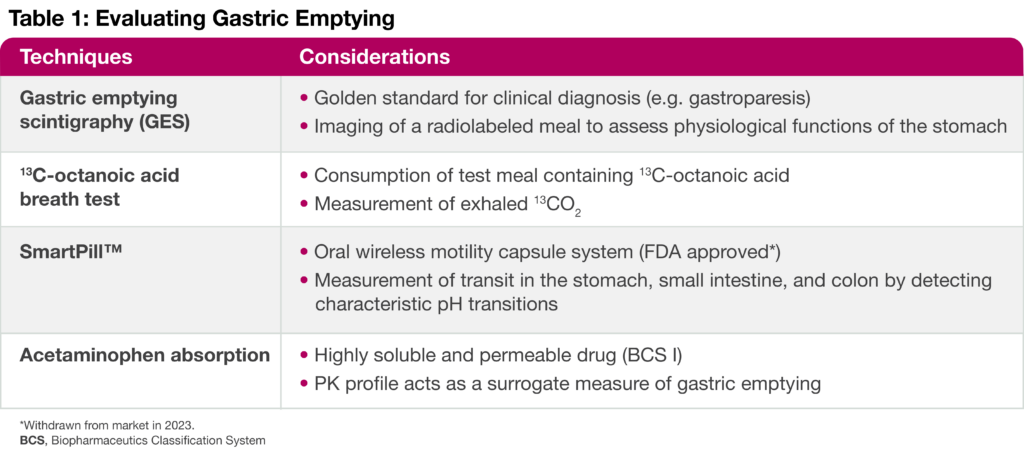
    There are several techniques to assess gastric emptying in a clinical setting (Table 1).  While scintigraphy is considered the gold standard for diagnostic purposes (e.g. for gastroparesis), an acetaminophen absorption assay applies classic pharmacology study designs to evaluate the role of gastric emptying in a drug-drug interaction study. In addition, the acetaminophen assay could be considered as a better predictor of drug absorption than the other approaches. In this assay, healthy volunteers consume acetaminophen dissolved in yogurt after administration of either a single dose or multiple doses (steady-state) of a drug that putatively alters gastric emptying.  Then, changes in the acetaminophen PK profile are compared to a baseline or placebo condition. 

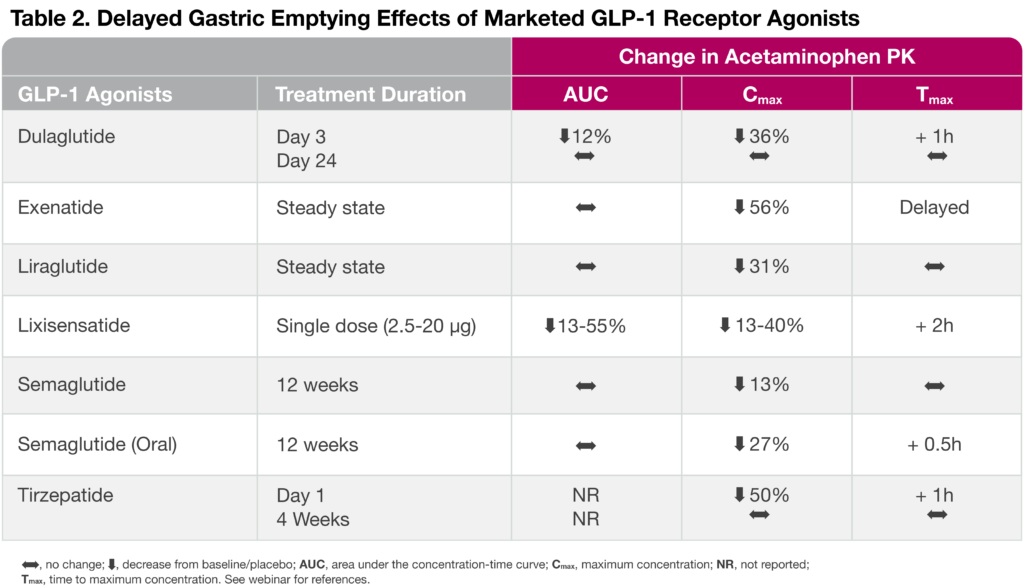
    When gauging acetaminophen absorption effects across various marketed GLP-1 receptor agonists, the overall acetaminophen maximum plasma concentration (Cmax) was reduced by 13-56%, a hallmark of delayed gastric emptying (Table 2).  Interestingly, the GLP-1 receptor agonist, dulaglutide, and the dual GLP-1 and GIP receptor agonist, tirzepatide, are both characterized by a strong delayed gastric emptying upon a single dose administration, but the effect tends to subside as gastric emptying tachyphylaxis is observed after several weeks of treatment.  Nonetheless, the tirzepatide effect of delayed gastric emptying was found to significantly reduce oral contraceptive PK by ~ 60% and, thus, the drug label advises patients using oral hormonal contraceptives to switch to or add a non-oral contraceptive method when initiating tirzepatide and after each dose escalation.

    Biopharmaceutics Classification System (BCS) and Delayed Gastric Emptying

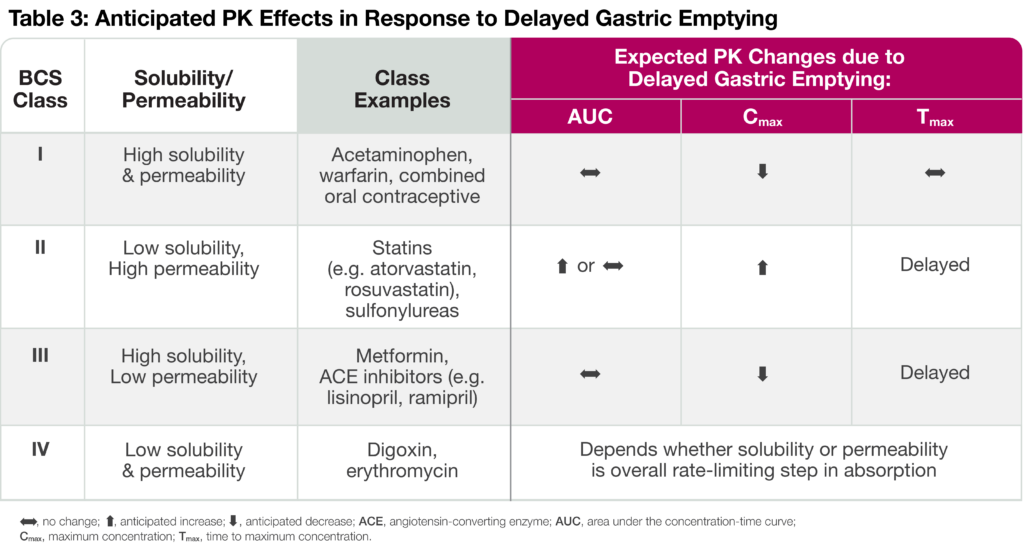
    The rate of drug absorption depends on the solubility and permeability of an orally administered product.  Solubility refers to the dissolution of the drug in an aqueous media, whereas permeability is the ability of a drug to cross membrane barriers and enter into the bloodstream.  Oral small molecules, therefore, fall into one of four BCS categories depending on their solubility and permeability characteristics (Table 3).  Delayed gastric emptying and reduced gastrointestinal (GI) motility can have different effects on drug PK dependent upon the drug’s BCS category.  For instance, Class I drugs like acetaminophen display reduced Cmax in response to delayed gastric emptying. On the other hand, increased residence in the stomach leads to a higher degree of dissolved drug available for absorption immediately after entering the small intestine, resulting in increased PK exposure and delayed time to maximum concentration (Tmax) for Class II drugs.  Reduced Cmax and delayed Tmax are anticipated for Class III drugs since intestinal permeability is rate-limiting.  Finally, the anticipated PK changes due to delayed gastric emptying depend on whether solubility or permeability is the overall rate-limiting step in absorption.

    A clinically relevant effect will depend on the extent of PK changes and the therapeutic index of the co-administered oral drug.  For instance, while many of the GLP-1 drug interactions investigated to date may be ‘statistically significant,’ no dose adjustment is required because they were not found to be ‘clinically relevant.’ The one exception is tirzepatide, as described above.  Nonetheless, for new GLP-1 drugs in development, it is imperative to evaluate potential drug interactions since this drug class can alter the efficacy of concomitant medications or increase the risk of adverse events as a result of higher exposure to a co-administrated drug.

    Conclusion

    GLP-1 receptor agonists have been known for their potential to delay gastric emptying. Consequent changes in AUC, Cmax, and Tmax values of orally administered concomitant medications may occur, which could impact drug efficacy or safety.  Therefore, if a new oral drug in development is intended to be co-administered with a GLP-1 agonist, we highly recommend conducting a healthy volunteer drug-drug interaction prior to Phase 3 trials to characterize the impact on the PK of the candidate new drug.  Similarly, novel GLP-1 receptor agonist-drug interaction studies evaluating the effect of delayed gastric emptying on the PK of oral medications from each BCS class should be considered.

    For more information, check out the webinar: Drug Absorption & Impact of Food, Gastric pH, Gastric Emptying and GLP-1 Agonists

  • How Healthy Volunteer Studies can Accelerate Oncology Drug Development

    By Sabina Paglialunga, PhD  & Aernout van Haarst, PhD; Senior Directors Scientific Affairs, Celerion

    Traditional drugs to treat cancer include chemotherapies, which are cytotoxic agents that non-specifically interrupt cell growth. While chemotherapy drugs effectively obstruct tumor development and growth, they also affect healthy cells, which can result in serious side effects as well as additional malignancies. Over the past two decades, alternative targeted therapies have emerged as less toxic options. Specifically, these drugs are designed to target and inhibit distinct molecular pathways involved in cancer cell growth and survival, such as tyrosine, serine, or threonine kinases. These enzymes and their receptors tend to be overexpressed in tumor cells and are involved in tumor cell proliferation, migration, and angiogenesis.

    Compared to conventional chemotherapies, kinase inhibitors are generally considered non-cytotoxic compounds and, therefore, can be administered to healthy volunteers, especially for early-phase clinical pharmacology studies. This approach not only de-risks clinical investigations in patients but can also accelerate drug development. Robust safety and pharmacokinetic (PK) data can be acquired from healthy volunteers for first-in-human (FIH), food effect, and drug-drug interaction (DDI) studies with efficiency, quality, and swiftness.

    Advantages of Healthy Volunteers over Patients:

    • More resilient human population if adverse events (AEs) occur:
      • AEs tend to be transient in nature, and healthy volunteers recover faster than patients do
    • Potential for less variable data
      • Healthy volunteers are not confounded by comorbidities that could result in data variability
    • Healthy volunteers are easier to recruit than most patient populations:
      • During early phase development, when efficacy has yet to be established, there is no potential benefit for patients, which may impact motivation to participate in a clinical trial
    • Patients are a more fragile population:
      • Due to polypharmacy, there may be potential drug interactions
    • Effect of disease on AE profiles:
      • In patient studies, care must be taken to distinguish drug-related AEs vs natural disease progression
    • Time and cost savings:
      • Development costs can be substantial as patient studies tend to require multiple sites, and slower recruitment can impact timelines

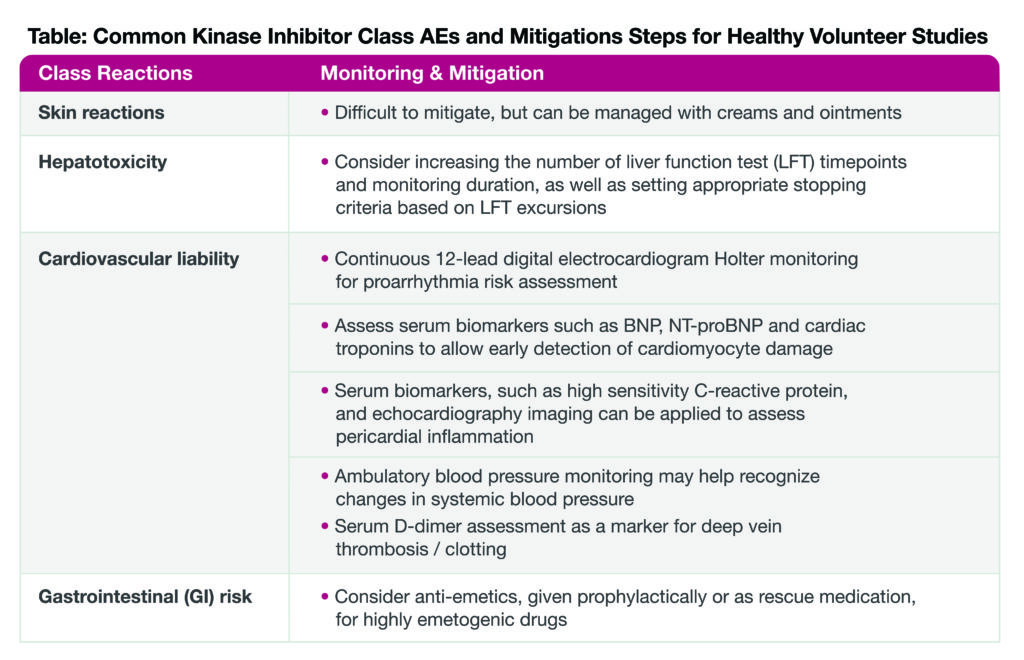
    In general, unless the investigational compound causes direct DNA damage, regulatory agencies typically allow the administration of healthy volunteers. Overall, tyrosine kinase inhibitors tend to have an acceptable safety profile that justifies administration in healthy subjects. Nonetheless, they are known to elicit certain adverse effects, such as skin reactions, hepatotoxicity, and cardiovascular and gastrointestinal side effects, yet several mitigation steps can be taken to prevent or overcome these common class AEs.  

    Product Labeling Studies to Support Regulatory Submission

    GI effects are quite common with kinase inhibitors; many cancer patients take acid-reducing agents (ARA) to help manage these side effects. The prevalence of ARA usage ranges between 20-70%, depending upon the cancer type, with GI and pancreatic cancers being the most widespread for ARA treatment. This is relevant for drug developers because of potential drug interactions between the kinase inhibitor and ARAs. In general, ARAs raise the stomach pH, making it a less acidic environment; this could reduce or increase drug bioavailability, which in turn could decrease efficacy or compromise safety, respectively.

    Recent FDA guidance provides a physiochemical framework when an ARA-drug interaction study is recommended. Proton-pump inhibitors (PPIs) are the class of ARAs typically evaluated in such DDI studies as they are considered a worst-case scenario due to their relatively strong and long-standing effects on stomach pH. Typically, these PPI studies enroll healthy volunteers and can be combined with a non-medicinal ARA (e.g. orange juice, coke) or food effect arm in a single study design to maximize data output and understand how ‘real word’ factors will impact drug PK.

    In addition to ARA DDI trials, other drug labeling studies that can be conducted in healthy volunteers include ADME, bioavailability(BA) / bioequivalent (BE), food effect, DDIs, and cardiac safety (TQT) assessments. These studies can support drug label claims and regulatory submissions. Conducting these studies in healthy volunteers allows for robust, high-quality data to be captured quickly.

    Conclusions

    In general, healthy, normal subjects can be considered for non-cytotoxic, small-molecule clinical trials, such as FIH, ADME, food effect, DDI, and cardiac safety (TQT) studies. Overall, Celerion has conducted over 140 clinical trials with kinase inhibitors since 2010. Relying on our extensive experience, we know how specific risks can best be mitigated. By leveraging data quality and saving time and costs, healthy volunteer oncology studies play a crucial role in accelerating cancer drug development, ensuring that only the most promising candidates proceed to patient populations at the safest dosing regimen.

    Learn more about our Product Labeling Clinical Pharmacology Studies on our resource page, or contact us at:  info@celerion.com.

  • Celerion’s US Pharmacies Expand On-Site Services, Ensure cGMP FDA Compliance for Phase 1 Investigational Drugs

    LINCOLN, Neb.; July 17, 2024 (Business Wire) – Celerion, a leading clinical research organization specializing in early clinical research and bioanalytical services, announces the launch of on-site services for rapid sterility testing (validated alternative method to USP <71>) and dose formulation analysis.

    Per FDA guidance, pharmaceutical products intended for parenteral administration must undergo sterility testing and provide results that meet stringent safety standards before reaching patients. Additionally, laboratory testing of Phase 1 investigational drugs must be completed to evaluate quality attributes including identity, strength, potency, and purity. Celerion’s comprehensive approach includes a fully integrated pharmacy and analytical laboratory facility.

    Celerion’s on-site pharmacy allows for “just in time” flexible formulation, saving clients time and money. Leveraging state-of-the-art equipment and expert analysis, Celerion refines pharmaceutical dosage formulations efficiently and effectively. This enables seamless compound analysis and testing, optimizing efficiency, speed, and control throughout development and testing phases.

    “Offering comprehensive analysis and testing capabilities under one roof provides sponsors with rapid, reliable solutions that meet regulatory requirements without compromising quality,” said Chad Briscoe, Ph.D., Executive Vice President, Global Bioanalytical Sciences.

    “In the face of evolving regulations, timely access to accurate sterility test results is paramount,” said Phil Bach, Executive Vice President, Global Clinical Research. “Our in-house capabilities for sterility testing and analysis allow us to accelerate this critical step within our controlled environment, providing sponsors with unparalleled speed and development schedule oversight.”

    About Celerion
    Celerion, a global leader in early clinical research services, offers a unique combination of medical expertise, clinical operations experience, and scientific excellence that gives its clients the confidence to make fast, accurate decisions about their drug development path.

    For over fifty years, Celerion has leveraged the latest operational concepts and technologies to execute safety/tolerability, pharmacokinetic, and pharmacodynamic studies in highly controlled clinical environments. These include first-in-human dose escalation, drug-drug interaction, cardiac safety, bioequivalence and bioavailability, metabolism, and excretion studies, as well as pharmacokinetic evaluations in patients with impaired renal or hepatic function. In addition, Celerion offers data management, biostatistics, clinical monitoring, and bioanalytical services. Our founding mission is to help our clients get their drugs to market quickly, so that they touch the lives of our family, friends, and people in need around the world. For more information, please visit www.celerion.com.

  • Celerion Honored With Prestigious CRO Leadership Award for Ninth Consecutive Year 

    LINCOLN, Neb.; June 5, 2024 (Business Wire) Celerion, a leading clinical research organization, is pleased to announce it has received a CRO Leadership Award for the ninth time by global biopharmaceutical executives in Life Science Leader’s annual CRO Leadership Awards for 2024. 

    Celerion was distinguished among 42 of their peers in the annual Contract Research Quality Benchmarking online survey conducted by Industry Standard Research. Celerion was recognized as a CRO Leader in the quality, capabilities and reliability categories across two groups of respondents (small pharma and combined big and small pharma). 

    “We are deeply honored to receive this award, which reaffirms our commitment to helping our clients bring life-changing medicines to market,” said Celerion CEO Susan Thornton, Ph.D. “This achievement would not have been possible without the trust and collaboration of our valued clients. We extend our heartfelt gratitude to them for their partnership in driving meaningful progress and improving patient outcomes.” 

    About Celerion 

    Celerion, a global leader in early clinical research services, offers a unique combination of medical expertise, clinical operations experience, and scientific excellence that gives its clients the confidence to make fast, accurate decisions about their drug development path. 

    For over fifty years, Celerion has leveraged the latest operational concepts and technologies to execute safety/tolerability, pharmacokinetic, and pharmacodynamic studies in highly controlled clinical environments. These include first-in-human dose escalation, drug-drug interaction, cardiac safety, bioequivalence and bioavailability, metabolism, and excretion studies, as well as pharmacokinetic evaluations in patients with impaired renal or hepatic function. In addition, Celerion offers data management, biostatistics, clinical monitoring, and bioanalytical services. Our founding mission is to help our clients get their drugs to market quickly, so that they touch the lives of our family, friends, and people in need around the world. For more information, please visit www.celerion.com

  • Key Clinical Pharmacology Studies to Support Biologic Drug Regulatory Submission

    By Sabina Paglialunga, PhD  & Aernout van Haarst, PhD; Senior Directors Scientific Affairs, Celerion

    Biologic drugs are pharmaceutical products derived from living organisms or their components. They represent a wide range of therapeutic treatments that include monoclonal antibodies, proteins, peptides as well as cell and gene therapies.  Oligonucleotide therapeutics, on the other hand, may in principle be synthetic drugs, but by targeting specific RNA sequences to alter RNA and/or protein expression, they share certain features of true biologics. Generally, biologics and oligonucleotide drugs offer several advantages over traditional small molecule products such as targeted therapy,  longer half-life (which can be associated with less frequent dosing leading to greater patient adherence) and even higher potency resulting in greater effectiveness. However, unlike most small molecules, plasma pharmacokinetic (PK) profiles of biologics and oligonucleotides may not reflect the target tissue distribution therefore, in some cases appropriate biomarkers or measures of target engagement may need to be assessed as an equivocal dose-effect relationship.

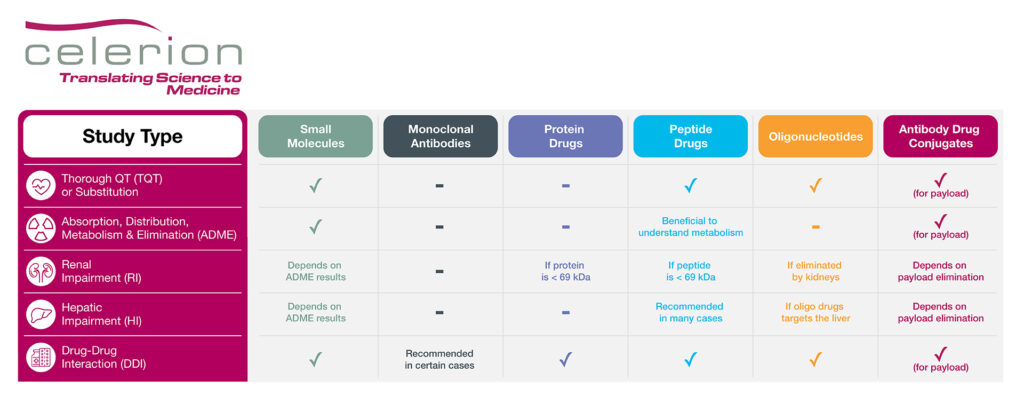
    With biologics and oligonucleotide drugs playing an important role in modern medicine, over the past few years the FDA has issued updated guidance for oligonucleotides (draft 2022), peptides (draft 2023) and antibody drug conjugates (ADC; final 2024) to further promote these areas of drug development. Notably, many of the clinical pharmacology studies recommended to support small molecule regulatory submission, as well as efficiencies in corresponding study designs, may also pertain to biologics and oligonucleotide drugs. For example, if safe to do so, enrollment of healthy volunteers (HV) can expedite drug development, as this group is faster to recruit, associated with less variability in PK data, and have no confounding co-morbidities or concomitant medications compared to patients. The below table highlights which key clinical pharmacology studies may be recommended for each drug type.

    Table: Key Clinical Pharmacology Studies to Support Drug Regulatory Submission

    Product Labeling Clinical Pharmacology Studies

    While large biologic drugs such as monoclonal antibodies and proteins are exempt from cardiac proarrhythmia risk assessment, a dedicated thorough QT (TQT) study may be recommended for peptide and oligonucleotide drugs, especially if a TQT substitution request via IHC E14 Q&A 5.1 or 6.1 is not sought.

    A mass balance study employing a radiolabel is typically recommended for small molecules to understand and track adsorption, distribution, metabolism and elimination (ADME) of the parent drug. While not necessary for biologic and oligonucleotide drugs, there may be cases where an ADME study could be beneficial for peptide products, especially if their distribution and elimination pathways are unknown.  The ADME study could also help inform the necessity of organ insufficiency PK studies, such as renal or hepatic impairment studies.  For instance, if a protein or peptide drug is < 69 kDa, meaning small enough to be filtered by the kidneys, a renal impairment study is recommended.  Similarly, a renal impairment PK study is recommended for oligonucleotide drugs if the therapeutic product is substantially eliminated by the kidneys. In addition, if the oligonucleotide drug targets the liver as part of its mechanism of action, a hepatic impairment PK study should be conducted. Peptides tend to be rapidly degraded by proteases and peptidases, bypassing hepatic elimination, thus negating the need for a hepatic impairment study. However, the recent draft FDA guidance document on peptide drug development does recommend a hepatic impairment PK study under certain conditions, such as:

    • The peptide drug is anticipated to undergo substantial hepatic metabolism or biliary excretion
    • The (lipid-conjugated) peptide drug is highly bound to serum albumin
    • The peptide drug’s pharmacological activity affects normal liver function

    Finally, a drug-drug interaction (DDI) study may be recommended if the biologic or oligonucleotide product is a CYP or transporter substrate or modulator, or if a PD interaction with a concomitant medication is anticipated. For example, glucagon like protein-1 (GLP-1) analogs may delay gastric emptying, thereby affecting the absorption of co-administered treatments. In addition, therapeutic proteins that are proinflammatory cytokines or up/down-regulate cytokines levels may also need to be evaluated for DDI potential. 

    Special Considerations for ADC Drug Development

    ADCs combine both small molecule and biologic drug components. The small molecule, often referred to as a ‘payload’, is conjugated to an antibody or an antibody fragment via a chemical linker. The antibody portion of the drug directs the payload to a specific tissue or target cell. Due to the combination of small molecule and biologic drug aspects, clinical pharmacology studies may be recommended to assess the unconjugated payload as well as the ADC or the total antibody, as necessary. 

    Conclusion

    Clinical pharmacology studies such as TQT/cardiac safety, ADME, renal & hepatic impairment or DDI trials may be recommended for biologic and oligonucleotide drug development, depending on the type, size, PK profile and/or PD effects of the product. Celerion’s experienced team of scientific and operational experts are ready to support your biologic drug development program with efficient protocol design, effective study conduct and reliable data management & analysis. 

    Learn more about our Product Labeling Clinical Pharmacology Studies on our resource page, or contact us at:  info@celerion.com.

  • Jo Goodman Joins Celerion as Vice President of Bioanalytical Services

    LINCOLN, Neb.; May 7, 2024 (Business Wire) – Celerion, a leading clinical research organization, specializing in early clinical research and bioanalytical services, today announced the appointment of Jo Goodman as Vice President of Bioanalytical Services in its Lincoln, Nebraska, laboratory.

    In her new role, Goodman will oversee the strategic direction and operational performance of the Lincoln bioanalytical laboratory, leveraging her extensive experience in pharmaceutical research and development to drive innovation and design and execute customized bioanalysis for clients’ needs. She will be responsible for delivering on Celerion’s bioanalytical promise of industry-leading science, stringent compliance, and speed of delivery.

    With over 29 years of experience in the pharmaceutical industry, Goodman brings a wealth of knowledge in regulated GxP and discovery bioanalysis for both in-house and outsourced activities. Prior to joining Celerion, she held positions of increasing responsibility at AstraZeneca, MedImmune, and GlaxoSmithKline. Additionally, Goodman is a recognized thought leader, having recently served as a member of the Expert Working Group (EWG) for ICH M10 Bioanalytical Guidance Development and is active in numerous non-profit industry consortia such as EBF, AAPS, and DMDG.

    “We are delighted to welcome Jo Goodman to our team,” says Dr. Chad Briscoe, Celerion’s executive vice president of global bioanalytical services. “Her proven track record of leadership, globally recognized reputation, and expertise in bioanalytical services will be invaluable as we continue to expand our capabilities and provide superior solutions to our clients.”

    About Celerion
    Celerion, a global leader in early clinical research services, offers a unique combination of medical expertise, clinical operations experience, and scientific excellence that gives its clients the confidence to make fast, accurate decisions about their drug development path.

    For over fifty years, Celerion has leveraged the latest operational concepts and technologies to execute safety/tolerability, pharmacokinetic, and pharmacodynamic studies in highly controlled clinical environments. These include first-in-human dose escalation, drug-drug interaction, cardiac safety, bioequivalence and bioavailability, metabolism, and excretion studies, as well as pharmacokinetic evaluations in patients with impaired renal or hepatic function. In addition, Celerion offers data management, biostatistics, clinical monitoring, and bioanalytical services. Our founding mission is to help our clients get their drugs to market quickly, so that they touch the lives of our family, friends, and people in need around the world. For more information, please visit www.celerion.com.

    Media Contact: 
    Michelle Maklas-Baker 
    Associate Director, Global Marketing 
    +1 732-306-7804 
    michelle.maklasbaker@celerion.com

  • 12 Questions to Help Guide Renal Impairment PK Study Design

    By Sabina Paglialunga, PhD  Director Scientific Affairs, Celerion

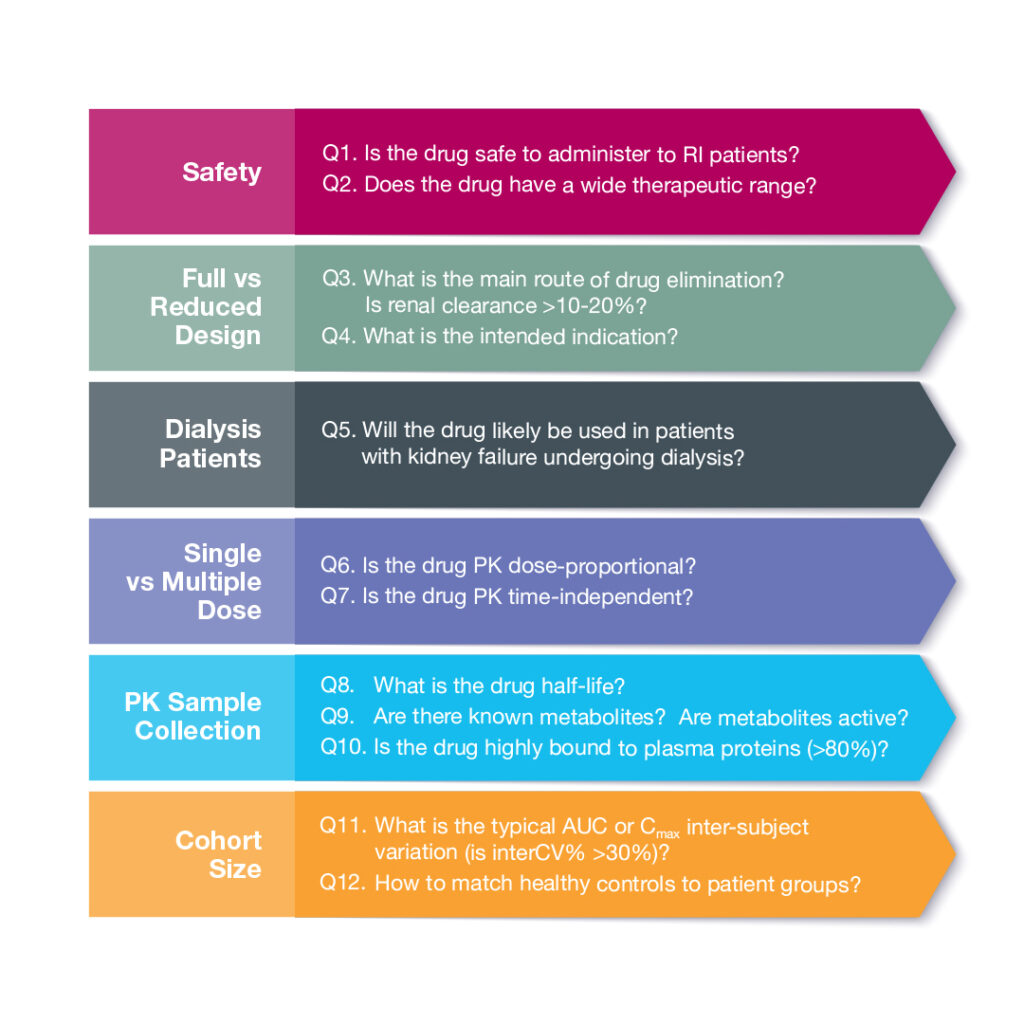
    Need to run a renal impairment pharmacokinetic (PK) study, but don’t know where to begin? We have  you covered! Celerion has managed more than 30 renal impairment PK studies over the past decade. We have a network of clinical sites and access to patients. To begin, we’ll guide you through 12 key questions to optimize study design.

    Safety First

    The first set of questions (Q1&2) relates to the safety profile of the drug in development. Is the investigational product safe to administer to patients with kidney dysfunction? If the study drug exacerbates kidney dysfunction, then it may not be suitable to dose in renal impaired participants. Next, we should consider the therapeutic range, as an increase in adverse events (AEs) and safety concerns may arise in patients with altered kidney function if the range is narrow.

    Design Foundations

    Assuming we are in the clear on these two fronts, we can then address the type of study needed (Q3&4). The FDA guidance, refers to full and reduced study designs. A full study explores the spectrum of organ dysfunction with cohorts ranging from normal → mild → moderate → severe, and in some cases kidney failure. A reduced study examines both ends of the continuum to compare normal vs severe conditions. If the investigational drug is mainly eliminated via the kidneys (i.e. renal clearance is > 10-20%) and/or is intended for patients with chronic kidney disease (CKD), then a full study is typically recommended. A reduced design is often sought when the investigational drug is likely to be administered to CKD patients yet the study drug is predominantly eliminated via the hepatobiliary route.

    A hemodialysis study (Q5) may be recommended if the study drug is likely to be used in patients undergoing dialysis; the drug is not highly bound to plasma protein, and is small enough to escape dialysis filtering.  In this case, the PK of the drug and any active metabolites are evaluated in patients both on- and off-dialysis days.  

    The dose regimen will depend on the PK characteristics of the study drug (Q6&7). A single dose may be administered if the drug exhibits dose-proportionality and displays time-independent PK. Multiple dose administration is often recommended when the drug or active metabolites show dose- or time-dependent PK characteristics.

    Sample Collection

    The following series of questions (Q8-10) help define the study sample schedule, collection, and analysis. In general, for renal impairment PK studies, blood samples are collected out to at least 3x the drug half-life. Metabolites representing >10% of total drug concentration should be measured in addition to the parent drug. If there is significant plasma protein binding, the unbound drug concentration should also be analyzed. Plasma protein binding is often altered in patients with renal impairment.  Per the FDA guidance, a limited number of unbound samples can be measured if binding is not concentration- or time-dependent. In this situation, we recommend to collect at least 2 time points per participant; one at baseline and one at Tmax.

    Cohort Size

    The next question to consider is the number of patients per cohort (Q11). The FDA guidance recommends a powered study and sample size justification based on PK variability. Depending on drug variability (interCV%), 9-14 patients per cohort may be recommended.

    Normal control matching is another question that regularly comes up during renal impairment study design discussions (Q12). We typically recommend the healthy control group to match patients by age (± 10 years), BMI (± 20%) and gender. There are two strategies, individual and mean matching. Individual or 1-to-1 matching allows for parallel patient and control enrollment, but can be difficult if a patient has uncommon characteristic. In some cases, a healthy control can match to more than one patient from different disease stage cohorts. With mean matching, the average values for the patient group are matched to the control subjects. This approach requires fewer subjects, but must wait until patient enrollment is complete. 

    Ready to Start

    With this information in hand, our team of operational and scientific experts can propose the ideal number of sites, recruitment timelines, and other study design considerations. Rely on Celerion for budget-friendly and streamlined processes that leverage our long-standing and established relationships with key renal impairment PK Principal Investigators.

    Check out our Renal/Hepatic Impairment PK Study Resource page for more information, or contact us at info@celerion.com