Weight reduction drugs are making a big splash! Since glucagon-like peptide 1 (GLP-1) receptor agonists were first approved for weight loss in 2021, there has been an estimated 700% increase in prescriptions in the US.1 This has led to a wave of new GLP-1 and incretin products entering into clinical research. Currently, there are nearly 150 novel GLP-1 receptor agonists in various stages of drug development globally.2 Beyond GLP-1, there are several other targets being explored for weight loss, also eager to swim in the same waters. In response, the Food and Drug Administration (FDA) recently updated guidance for industry to support drug development: Obesity and Overweight: Developing Drugs and Biological Products for Weight Reduction
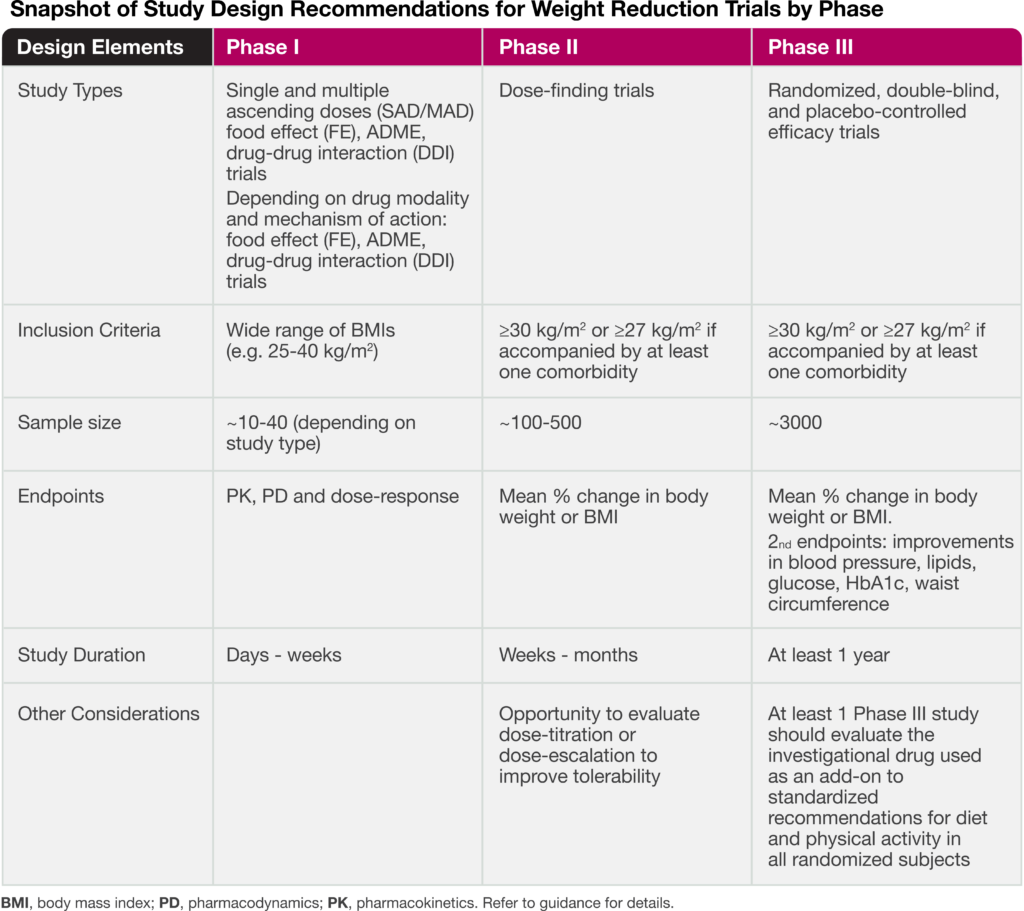
The guidance addresses key aspects for drug developers, including recommendations for early and late phase trials, as well as input on sample size and primary endpoints. The following table highlights important study design elements.
As recently discussed in our blog article: Reframing the Definition of Obesity, the draft guidance also places emphasis on utilizing body mass index (BMI) for inclusion/exclusion criteria as well as the percent change in BMI for a primary endpoint. The FDA recognizes that while BMI is not a direct measure of adiposity (fat mass), it is a simple and effective assessment in which at least a 5% reduction is generally associated with improvement in metabolic and cardiovascular risk factors. In addition, to ensure the weight reduction effect is not due to loss of lean-body mass, body composition assessment by dual x-ray absorptiometry (DEXA) or another imaging modality is highly advised.
Safety Assessments for Weight Reduction Drugs
In terms of safety assessments, the FDA recommends monitoring changes in blood pressure and lipids. Early phase studies, such as SAD/MAD, also provide an opportunity to assess proarrhythmic risk (i.e., QTc prolongation), as well as immunogenicity potential for biologic therapies, including peptide drugs. The guidance also recommends including C-SSRS questionnaires for centrally acting drugs and echocardiographs for serotonin inhibitors.
Combination Products
Common adverse events associated with current GLP-1 therapies include nausea, vomiting, and muscle mass loss. To that end, an emerging trend is to optimize weight loss and minimize potential side effects with combination products. The guidance recommends assessing the safety and PK of each component in Phase I studies prior to initiating late-stage fixed-combination drug products trials.
Diving into Celerion’s Weight Reduction Experience
Celerion has extensive experience with a wide range of compounds for weight reduction, including GLP-1 receptor agonists, insulin sensitizers, and microbiota products. Our comprehensive experience with anti-obesity drugs covers all aspects of development; from first-in-human studies and proof-of-concept trials to clinical pharmacology studies to support labeling, such as drug-drug interaction – and bioavailability/bioequivalence studies.
Conclusion
As research in this indication continues, one can anticipate that the next generation of weight reduction therapies will render better safety profiles, more convenient drug administration (e.g., oral products or less frequent subcutaneous dosing), and improved patient adherence. Celerion is ready to help navigate the regulatory waters and support drug developers by leveraging our early phase clinical research experience, expertise, and efficiencies for smooth sailing ahead!
LINCOLN, Neb.; May 6, 2025 (Business Wire) – Celerion, a global leader in early clinical research and bioanalytical services, announced the launch of the latest version of Labnotes, its cutting-edge bioanalytical electronic laboratory notebook software, elevating data handling and analysis capabilities for sponsors.
The latest system enhancements streamline laboratory documentation and improve operational efficiency for users. The updated platform also offers advanced tools for handling and organizing large datasets, ensuring faster processing of reports and optimized database queries.
“With this enhanced version, Celerion underscores its commitment to expanding the use of cutting-edge technology to support its clients in achieving business success,” said Chad Briscoe, Executive Vice President of Global Bioanalytical Services at Celerion. “These improvements demonstrate our continued commitment to innovation and excellence in all facets of our laboratory operations.”
Celerion also introduced robust features to support security and flexibility. Enhanced encryption and secure access controls guarantee data protection, while new archiving and extraction tools enable secure data sharing without requiring the core software. Additionally, the inclusion of a Report API allows seamless integration with external reporting tools, providing users with tailored reporting capabilities to meet their specific needs.
“Our approach to software development is rooted in customer feedback and the latest industry trends. The updates in Labnotes empower clients with robust tools to manage and analyze their data effectively, enabling better decision-making and driving impactful business outcomes, said Mark Williams, CEO of Terrington Data Management.
About Celerion
Celerion, a global leader in early clinical research, offers clients expert-driven services that enable fast, informed decisions in drug development. With over 50 years of experience, Celerion specializes in Phase 1 studies, including first-in-human dose escalation, drug-drug interactions, cardiac safety, bioequivalence, metabolism, and pharmacokinetics in patient populations. Celerion also provides comprehensive data management, biostatistics, clinical monitoring, and bioanalytical services. For more information, visit www.celerion.com.
About Terrington Data Management
Terrington Data Management provides specialist software solutions to a variety of international customers, including clients within Oil, Gas, Pharmaceutical, Chemical and Manufacturing Sectors. The company’s software is designed to securely store, collect and utilize business information in order to improve overall business workflow.
Labsform, DocMan and OPAL were developed to meet the requirements of laboratory scientists working in tightly regulated bioanalytical laboratories to enhance productivity, streamline workflows and improve compliance. The software has since been used in laboratories across the world serving a variety of disciplines from R & D to clinical management. For more information, visit www.labsform.com.
By Johannes Stanta, PhD, Global Scientific Director, Celerion Inc.
As drug development continues to evolve, few areas are advancing as disruptively as cell and gene therapies (CGTs). These highly complex and often personalized treatments are redefining what is possible in modern medicine. But while the science has leapt forward, many of the tools and assumptions behind therapeutic development have not. In particular, our continued reliance on animal models is becoming an increasingly obvious limitation.
That is where Model-Informed Drug Development (MIDD) comes in, and why now is the time to reexamine how we generate, interpret, and act on data throughout the development process.
Why Animal Models Fall Short for CGTs
CGTs operate through fundamentally different mechanisms than small molecules and biologics. Many of these therapies are intended for one-time administration, with long-lasting effects driven by genome editing, transgene expression, or cellular persistence. They do not follow classical dose-response relationships, do not exhibit linear clearance, and often behave in ways that are highly patient-specific and immune-mediated.
Despite this, drug developers and regulators continue to apply drug development frameworks designed for small molecules, relying on assumptions about repeated dosing, systemic pharmacokinetics, and linear modelling. This disconnect between therapeutic modality and development model often results in inefficiencies, suboptimal trial designs, and an overreliance on animal models that offer limited predictive value. Some regulatory agencies are beginning to acknowledge this gap. The FDA Modernization Act 2.0 and the agency’s 2024 roadmap to reduce animal testing both signal a shift toward more human-relevant, model-based approaches.
The Role of MIDD in CGT Development
MIDD integrates quantitative modelling, simulation, and data-driven decision-making across the product lifecycle. In the context of CGTs, this includes modelling the expansion, contraction, and persistence of engineered cells, predicting vector biodistribution across human tissues using physiologically based pharmacokinetic (PBPK) models, and understanding complex interactions between the therapy, disease pathways, and host immune responses through Quantitative Systems Pharmacology (QSP).
These tools make it possible to simulate hypothetical scenarios, define safe and effective first-in-human doses, and design more informative early-phase trials …well before administering a dose to a volunteer. As a result, MIDD reduces risk, improve administration of effective doses and decreases dependence on translation of animal-based safety and efficacy studies.
Bioanalysis: The Unsung Hero
Models are only as good as the data that inform them. Bioanalysis plays a crucial role in enabling model-informed development. Whether measuring vector DNA by PCR, quantifying cell expansion through flow cytometry, or assessing an expressed protein via ligand-binding assays, high-quality bioanalytical data are the foundation of any meaningful model.
Advanced bioanalytical platforms such as LC-MS/MS, immunoassays, digital droplet PCR, spectral flow cytometry and in vitrofunctional assays are not merely supportive tools, they are essential for the development and application of MIDD. Moreover, these human-relevant technologies are central to the FDA’s strategy for reducing animal testing. In the development of CGTs, mechanism-based bioanalysis is no longer optional. It is a scientific and regulatory necessity.
Looking Ahead: AI, NAMs, and a New Development Ecosystem
MIDD does not exist in isolation. It is now embedded in a broader framework that includes artificial intelligence (AI), New Approach Methodologies (NAMs), and growing regulatory support for model-based submissions. AI and machine learning are already being used to identify pharmacodynamic endpoints, biomarkers, stratify patients, generate virtual populations, and simulate clinical outcomes. At the same time, NAMs (including organ-on-chip systems and in vitro immune models) are producing more human-relevant preclinical data than traditional animal models.
When combined, these tools offer a smarter and more responsive way to develop CGTs. They support a more predictive understanding of efficacy and safety, reduce dependence on animal models that are often poorly translatable, and improve development timelines by avoiding lengthy and costly primate studies that yield limited actionable insights. In vitro methods can generate targeted, mechanistic data that feed directly into model frameworks, making them not only faster and more cost-effective but also better suited to the biology of CGTs.
Yet, development budgets are still heavily weighted toward animal testing, not because it delivers superior science, but because it remains deeply embedded in the regulatory process. As MIDD and NAMs continue to mature and regulatory standards emerge, this logic will be reversed. The focus will shift to the tools that provide the most decision-relevant, human-specific data.
The MIDD-driven ecosystem is also inherently more compatible with personalized medicine. CGTs are frequently developed for narrow patient populations or even individual patients. Traditional animal models are not equipped to handle this level of variability, whereas MIDD allows developers to model population-level and individual responses with far greater precision.
Final Thoughts
As someone working at the intersection of CGTs, bioanalysis, and model-based development, I have seen firsthand how these approaches are converging—and how rapidly expectations are changing across the industry. What was once aspirational is now an operational reality.
If we want to unlock the full potential of CGTs, we must move beyond legacy frameworks. MIDD, informed by robust analytics and bioanalytical data, offers a clearer, more efficient, and more ethical path forward. This is not only better science—it is better drug development.
If you are asking similar questions or actively working to reduce reliance on animal models through smarter, model-based development strategies, we would love to connect.
At Celerion, we believe that innovation in the lab shouldn’t come at the cost of simplicity or security. That’s why we’re excited to announce the latest evolution of LabNotes, our bioanalytical electronic laboratory notebook (ELN) software designed to make data management more intuitive and more powerful than ever before.
Whether you’re managing massive datasets or juggling multiple timelines, the newest version of LabNotes was built with one goal in mind: to help our clients move faster, think smarter, and protect their data with confidence.
What’s New in LabNotes?
The upgraded platform brings a host of improvements focused on speed, scalability, and security:
Streamlined Laboratory Documentation – Simplified workflows reduce documentation time and improve day-to-day efficiency.
Enhanced Dataset Management – Advanced tools make it easier to organize, analyze, and report on large data sets.
Improved Query Optimization – Faster, more reliable database access to keep projects moving forward without delays.
Advanced Security Features – With upgraded encryption and access controls, data protection is built into every layer.
Flexible Data Sharing – New archiving and extraction features make it easy to share information securely—without needing to install or run the core software.
Custom Report Integration – A newly added Report API allows teams to connect with third-party reporting tools for fully tailored data outputs.
Built for the Way You Work
“With this enhanced version, Celerion underscores its commitment to expanding the use of cutting-edge technology to support its clients in achieving business success.,” says Chad Briscoe, Executive Vice President of Global Bioanalytical Services at Celerion.“ These improvements demonstrate our continued commitment to innovation and excellence in all facets of our laboratory operations.”
“Our approach to software development is rooted in customer feedback and the latest industry trends. The updates in LabNotes empower clients with robust tools to manage and analyze their data effectively, enabling better decision-making and driving impactful business outcomes”, says Mark Williams, CEO of Terrington Data Management
by Johannes Stanta, PhD – Global Scientific Director, Sabina Paglialunga, PhD – Senior Scientific Director, and Aernout Van Haarst, PhD – Senior Scientific Director
The FDA’s recent decision to support non-animal methods for the safety evaluation of monoclonal antibodies (mAbs) is a significant—and long overdue—step forward in modernizing drug development. While the scientific community has long embraced the 3Rs framework (Refine, Reduce, Replace), regulatory acceptance has historically lagged behind. This has limited the practical application of advanced non-animal technologies beyond academic discovery and internal candidate selection.
Until now, animal testing has remained a regulatory default—often considered mandatory—with little room for alternative strategies. Good Laboratory Practice (GLP) enforcement has added further rigidity, making it challenging to integrate more flexible, human-relevant tools into regulated programs.
A Question of Translation, Not Tradition
The limitations of animal models are well established. Across therapeutic areas, particularly in immunology and oncology, the predictive value of animal studies for human outcomes is poor. In the context of mAbs, these limitations are especially pronounced. Safety signals often arise from excessive pharmacologic action or immune activation, rather than classical dose-dependent, off-target toxicity. These mechanisms are difficult—if not impossible—to model in animals, where interspecies differences in immune architecture obscure translatability.
This regulatory shift now enables the broader use of validated New Approach Methodologies (NAMs)—including organoid models, immune microphysiological systems, and in silico tools—as part of safety packages for investigational new drug (IND) applications. Notably, the FDA will also begin accepting real-world human safety data from other regulatory jurisdictions, providing an opportunity to reduce duplicative and ethically questionable animal studies.
Opportunities and Challenges for the Field
This shift raises important questions for the drug development ecosystem:
Can NAMs provide sufficient data to inform a safe starting dose for a first-in-human study? The current mAb paradigm relies on minimal anticipated biological effect level (MABEL) or physiologically active dose (PAD) to establish a first starting dose. While the MABEL approach can be fulfilled without animal testing as it often includes in vitro receptor occupancy assessments, the PAD approach tends to comprise of animal models, which may require rethinking or development of newer methodologies to substantiate a non-animal model.
How do we build confidence in the performance of NAMs? While early data on systems like liver chips and cytokine release assays are promising, widespread adoption will require validation, reproducibility, and clearly defined regulatory contexts of use.
Are current laboratory infrastructures ready to support the complexity of these models? Organoids and microphysiological systems demand expertise in cell biology, tissue engineering, and real-time functional readouts. Integrating such technologies into a GLP-aligned environment is a non-trivial task, especially as these concepts have often been deployed in non-GLP discovery or academic settings.
What frameworks are needed to standardize these methods across sponsors and regulators? Without harmonized protocols, the interpretation of NAM-based safety data risks inconsistency, delaying regulatory confidence.
How will bioanalytical and pharmacokinetic modeling capabilities evolve to complement these in vitro systems? Tools like physiology-based pharmacokinetic (PBPK) modeling, quantitative systems pharmacology (QSP), and immunogenicity prediction will need to be deeply integrated into the workflow and accelerated using machine learning approaches to continuously improve outcomes and applicability.
What type of research organizations will be best equipped to navigate this transition? It is reasonable to envision that GLP-accredited laboratories combining molecular and cellular assay expertise, regulatory bioanalysis and tight integration with clinical trial units may be best positioned to bridge nonclinical insights and clinical execution.
A Critical Inflection Point
The field has been scientifically prepared for this transition for years. Now, with regulatory momentum finally aligning, the challenge is operational. The focus must turn to building capacity, ensuring reproducibility, and developing harmonized protocols while educating regulators to work with these tools effectively.
This move by the FDA is not just a policy update—it is a call to action. If implemented thoughtfully, it will accelerate development timelines, reduce costs, uphold ethical standards, and, most importantly, improve the relevance of preclinical data to human biology.
The burden now shifts to the industry to answer: Are we ready to let go of legacy models and build a nonclinical paradigm that truly reflects human physiology?
by Chad Briscoe, Executive Vice President, Global Bioanalytical Services, Celerion
Someone whom I’ve worked with in the past and have had an opportunity to mentor in the bioanalytical field for some time recently asked me about the U.S. federal court ruling on LDTs. I realized I don’t really understand it as well as I would like to or as well as I should, and that I hadn’t been as “up-to-speed” on the current status of LDTs as used in the US or Europe. I decided to dig in and pull together a blog to help me learn and also help provide a guide for others that may want something that summarizes the current situation as I understand it.
In a landmark legal decision announced by the ACLA (American Clinical Laboratory Association) on March 31, a U.S. federal court vacated the FDA’s attempt to regulate Laboratory Developed Tests (LDTs) as medical devices. This preserved the long-standing CLIA oversight. Essentially preserving the status quo.
Meanwhile, across the Atlantic, the European Union’s In Vitro Diagnostic Regulation (IVDR) has been tightening control over diagnostic innovation. These two contrasting regulatory directions are reshaping the landscape for clinical and bioanalytical laboratories. Here’s my interpretation of what it means, why it matters, and how labs (in particular bioanalytical labs) can stay ahead.
Laboratory-Developed Tests (LDTs) have become foundational to the rapid evolution of diagnostic science. In recent years, due to the increasing complexity of LDTs and the focus on biomarkers in traditional bioanalytical labs, this has become important to laboratories beyond just the traditional Clinical Laboratories, central laboratories, and local hospital labs. These custom assays—designed, manufactured, and used within a single or small number of laboratories—often address unmet clinical needs, are used to support clinical trials and new treatment options. These have become key tools in affordable precision medicine. However, their regulation has been in flux for over a decade, driven largely by activities in the United States and European Union.
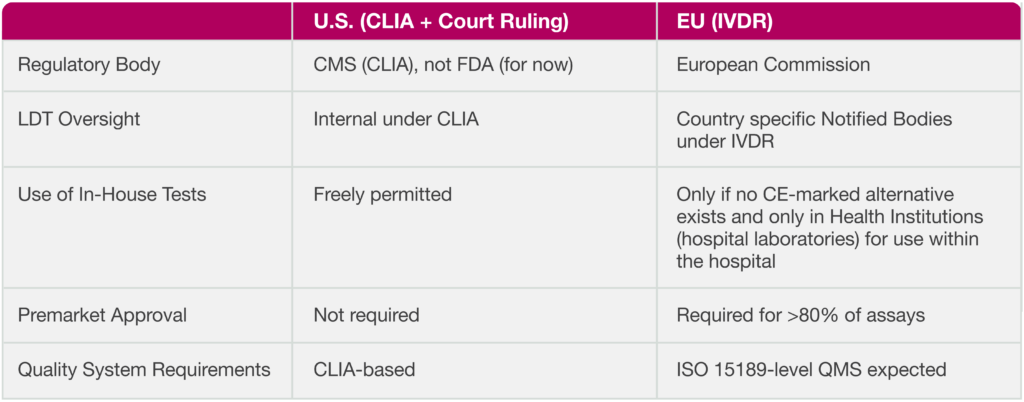
In the U.S., a federal court recently vacated the FDA’s 2024 final rule that sought to classify LDTs as medical devices. This decision, brought forward by the American Clinical Laboratory Association (ACLA), reasserts CLIA (Clinical Laboratory Improvement Amendments) as the primary regulatory authority over LDTs. In Europe, however, the new In Vitro Diagnostic Regulation (IVDR) has taken the opposite approach, intensifying regulatory oversight and requiring an onerous approval process with extensive documentation, validation, and risk classification for all diagnostic tests—including in-house laboratory tests.
Under the previous regulation, about 20% of laboratory tests were required to follow this path, but this has now increased to about 80% under IVDR.
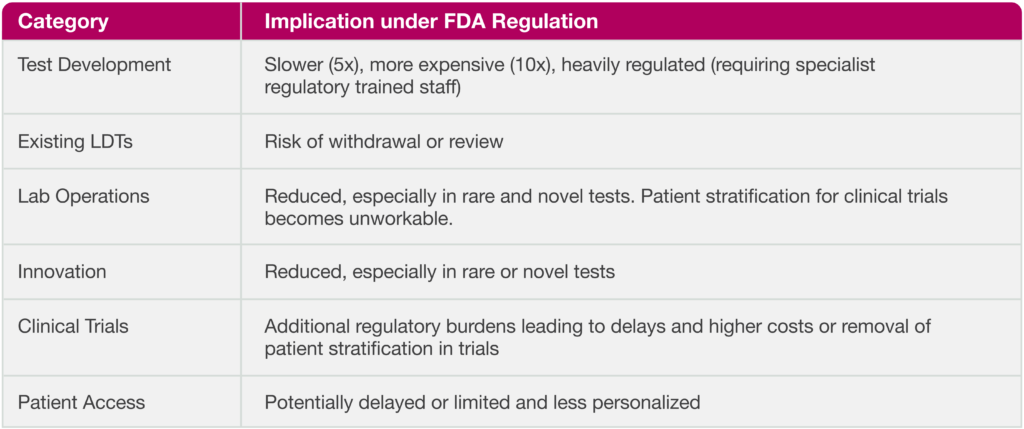
Implications of FDA Regulating LDTs (If ACLA lawsuit had failed)
The FDA’s now-overturned rule would have subjected LDTs to the same premarket review, labeling, and post-market surveillance required for commercial in vitro diagnostic devices, developed for a mass market. Critics, including ACLA and the Association for Molecular Pathology (AMP), argued that this overstepped statutory bounds, stifled innovation, and jeopardized access to critical diagnostics.
The court’s ruling provides:
Regulatory Stability: Labs may continue operating under CLIA without additional FDA burdens.
Innovation Breathing Room: LDTs can still be developed and deployed quickly, often in response to urgent or rare clinical needs.
Continued Responsibility: While FDA oversight is paused, labs must continue to maintain rigorous internal validation practices and high-quality standards.
For bioanalytical labs, this ruling helps sustain agile assay development, enabling continued support for clinical trials, specialty testing, patient stratification, patient enrollment, and companion diagnostics.
The EU’s IVDR, which came fully into effect in May 2022, represents a complete overhaul of how diagnostics are regulated. Replacing the former IVDD, the IVDR imposes:
Risk-Based Classification (Class A to D) – though most LDTs are highly complex and therefore high risk
Performance Evaluation Requirements – requiring navigating a complex network of national Notified Bodies with varying interpretations of IVDR
Strict Use Conditions for In-House Tests – Typically, only hospital laboratories qualify when the test is used within the hospital.
Mandatory Quality Management Systems – ISO15189 is suggested, but accreditation bodies struggle to accredit non-routine clinical laboratories
Market Justification for Each In-House Test – requirement for regulatory review for each assay by a Notified Body
In stark contrast to the U.S. model, the IVDR now requires labs to prove that no CE-marked equivalent exists before using an LDT. Labs must also implement formal procedures for ongoing safety, performance monitoring, and clinical evidence gathering.
Key Differences at a Glance
For labs operating in clinical trials, translational science, or patient diagnostics, these changes affect everything from compliance planning to assay design and budgeting.
In the U.S.:
Labs retain operational flexibility.
No new device-level regulatory filings required.
Opportunity for rapid test iteration and clinical trial support.
In the EU:
Labs face new regulatory hurdles.
In-house test development is resource-intensive.
There may be delays or discontinuation of certain novel assays due to compliance costs.
Patient stratification for clinical trials will be reduced or stopped unless absolutely necessary.
Multinational labs performing LDTs must now manage dual compliance strategies:
In the U.S., keep internal systems CLIA-compliant while monitoring the policy landscape (e.g., VALID Act proposals).
In the EU, prepare for full IVDR implementation—especially if supporting EU-based clinical trials or patient testing.
Labs performing cross-border testing (e.g., EU patients using U.S.-based services) will need to harmonize quality, documentation, and reporting standards to remain compliant with IVDR, even if physically located outside the EU. Laboratories outside the EU struggle to find the correct national Notified Body that will review and approve their IVD assay.
The divergence between U.S. and EU regulation poses challenges—but also raises important questions:
Can future legislation, such as the VALID Act in the U.S., find a middle ground between oversight and innovation?
Will the EU refine or delay IVDR enforcement based on implementation feedback?
How can international standards be aligned to ease burdens for global labs?
Industry advocacy groups like ACLA and AMP are already working toward legislative solutions, while European regulators are issuing guidance to clarify IVDR expectations. Collaboration across borders will be key to future success.
Whether you’re a clinical lab director, regulatory affairs lead, or scientist in a bioanalytical CRO, the message is clear: the regulatory environment for diagnostics is evolving—rapidly and asymmetrically.
• In the U.S., the recent court decision protects flexibility and self-regulation—for now.
• In Europe, IVDR brings new rigor and central oversight—but also risks of reduced innovation.
• Globally, labs must adapt or risk falling behind.
As science continues to evolve and offers the opportunity for personalized medicine, regulatory oversight shouldn’t stand in the way of enabling it; instead, it should find a way to accelerate the safe implementation. In our industry, public health regulations that enable advanced clinical trial designs and early patient access to innovative new medicines are just as critical as scientific advancement.
Now is the time for bioanalytical labs to strengthen their quality systems, shake the fear of innovative solutions, and advocate for smart, science-driven oversight that puts patients first.
Two notable guidance documents addressing obesity and weight loss were issued in January 2025. Surprisingly, they have differing opinions on the role body mass index (BMI) plays in the definition of obesity and the clinical management of patients with obesity.
The recent FDA guidance defines obesity as a chronic disease characterized by excess adiposity and recommends using BMI, an anthropometric index, to classify weight groups. BMI is calculated as:
BMI = weight (kg) / [height (m)]2
The formula has been around since the 1800’s. It was developed by Adolphe Quetelet, a Belgian statistician, mathematician, and astronomer, in 1832. However, it wasn’t validated as a measure of obesity until the 1970s by physiologist Ancel Keys (reviewed in Pray & Riskin). Now, BMI is commonly applied to assess health and stratify disease risk. BMI cutoff values are applied to classify overweight (25-29.9 kg/m2) and obesity class 1 (30-34.9 kg/m2), obesity class 2 (35-39.9 kg/m2) and extreme obesity (≥40 kg/m2).
Weighing the Utility of BMI
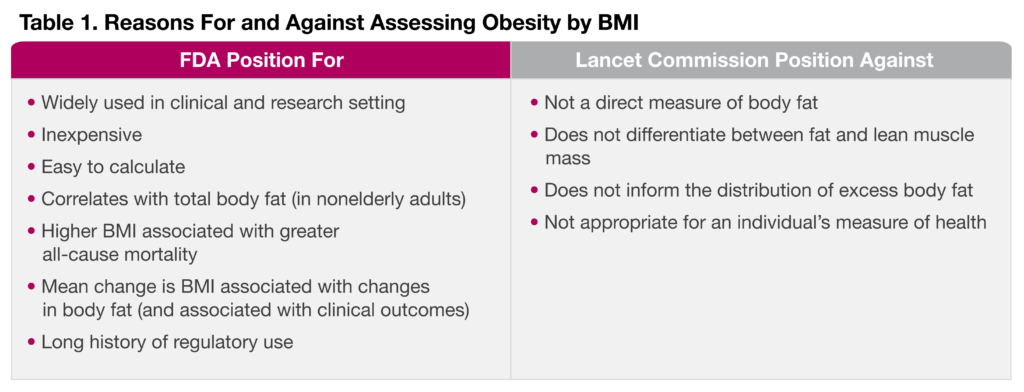
While BMI is a convenient and long-standing measure to assess obesity, it does not differentiate between fat and lean muscle mass. It can either under- or over-estimate adiposity (fat mass). For example, older adults, conditions associated with bone or muscle mass loss, and certain ethnicities are prone to underestimation of obesity and fat mass by BMI, while conversely athletes could have overestimated obesity rates. Therefore, the Lancet Commission recommends that excess adiposity should be confirmed by either of the following as a second measure of fat mass, in addition to BMI:
Waist circumference
Waist-to-hip ratio
Waist-to-height ratio
Bioimpedance
Direct measures of body fat such as dual X-ray absorptiometry (DEXA) or magnetic resonance imaging (MRI)
One exception, however, is that clinicians may assume that a patient with a BMI ≥40 kg/m2 displays excess adiposity. The arguments to utilize or limit BMI in determining obesity are as follows.
Redefining Obesity
More poignant, the Lancet report also provides an updated and evidence-based definition of obesity, applying clinical and biological criteria for the diagnosis of this chronic illness.
Clinical obesity: a chronic, systemic illness characterized by alterations in the function of tissues, organs, the entire individual, or a combination thereof due to excess adiposity. Clinical obesity can lead to severe end-organ damage, causing life-altering and potentially life-threatening complications (e.g., heart attack, stroke, and renal failure).
Preclinical obesity: a state of excess adiposity with preserved function of other tissues and organs and a varying, but generally increased, risk of developing clinical obesity and several other non-communicable diseases (e.g., type 2 diabetes, cardiovascular disease, certain types of cancer, and mental disorders).
The aim of reframing the definition of obesity and its assessment is to encourage more accessibility and effective management for those with an unmet need. Until recently, obesity alone, without the presence of other diseases, was not considered a disease in itself (reviewed in Rubino et al.). This potentially led to negative implications for treatment options and insurance coverage for those with excess body fat without other comorbidities. However, relying on BMI alone with these new definitions could lead to overdiagnosis of obesity, therefore direct excess fat assessment in addition to physical work-up is recommended.
Conclusion
While these two reports may seem at odds with each other, the Lancet Commission does concede that BMI should be used only as a surrogate measure of health risk at a population level, for epidemiological studies, or screening purposes. The latter is most notable for drug developers. Therefore, in line with the FDA guidance, BMI will continue to be the main inclusion criteria for weight loss clinical trials. However, additional markers of excess fat could provide better insight into drug effects on adiposity. To that end, Celerion has extensive experience with weight reduction drugs, including GLP-1 receptor agonists, insulin-sensitizing drugs, and microbiota products. We also offer a full range of adiposity assessments, including BMI, body weight, waist circumference, and bioimpedance, as well as sophisticated imaging assessments such as DEXA, MRI, and FibroScan® (liver fat content).
Reference
FDA. Obesity and Overweight: Developing Drugs and Biological Products for Weight Reduction Guidance for Industry. 2025. https://www.fda.gov/media/71252/download
Pray R, Riskin S. The History and Faults of the Body Mass Index and Where to Look Next: A Literature Review. Cureus. 2023 Nov 3;15(11):e48230. DOI: 10.7759/cureus.48230
Rubino F et al. Redefining obesity: advancing care for better lives. The Lancet Diabetes & Endocrinology. 2025 Jan 14;13(2):75. DOI: 10.1016/S2213-8587(25)00004-X
LINCOLN, Neb.; Feb. 19, 2025 (Business Wire) – Celerion, a global leader in early clinical research, proudly announces a new agreement to relocate its U.K. Phase 1 clinical research operations to iREACH Health. This state-of-the-art clinical research center, led by Queen’s University Belfast, in partnership with the Belfast Health and Social Care Trust, is set to become a cornerstone of Northern Ireland’s life sciences innovation ecosystem upon its early 2027 completion.
Celerion’s Belfast clinic has a history of clinical research excellence spanning more than 30 years, marked by continual growth, expanding capabilities, and strong partnerships with academic and medical institutions. Relocating to iREACH Health positions Celerion at the forefront of clinical research innovation, facilitating collaboration across government, industry, and academia to advance novel therapies for patients in need.
iREACH Health will be situated across two buildings beside Belfast City Hospital. The clinical research innovation center will include a 100-bed Phase 1 facility designed to Celerion’s specifications, equipped to support its U.K. team, including a highly experienced full-service data management, medical writing, and biometrics group. This team of early development experts specializes in adaptive study design, protocol development, clinical data sciences, PK/PD analysis, and statistical reporting, delivering data-driven insights that reduce risk and optimize trial outcomes.
“We’re thrilled to build on our long-standing relationship with Queen’s University Belfast by relocating to this world-class center,” said Phil Bach, Celerion’s Executive Vice President of Global Clinical Research. “Our new home at iREACH Health will enhance the speed and efficiency of our Phase 1 clinical trials, supporting our clients in accelerating drug development timelines.”
Professor Judy Bradley, CEO of iREACH Health, highlighted the innovation center’s vision: “Our aim is to deliver agile, people-centered clinical trials that are innovative, data-driven, and digitally enabled. We are delighted to work with Celerion to advance those plans and tackle some of Northern Ireland’s most pressing healthcare challenges. This partnership with Celerion will help deliver significant benefits for the region and beyond, driving advancements in healthcare whilst supporting economic and social outcomes.”
About Celerion Celerion, a global leader in early clinical research, offers clients expert-driven services that enable fast, informed decisions in drug development. With over 50 years of experience, Celerion specializes in Phase 1 studies, including first-in-human dose escalation, drug-drug interactions, cardiac safety, bioequivalence, metabolism, and pharmacokinetics in patient populations. Celerion also provides comprehensive data management, biostatistics, clinical monitoring, and bioanalytical services. For more information, visit www.celerion.com.
LINCOLN, Neb.; Dec. 4, 2024 (Business Wire) – Celerion, a global leader in early clinical research, is proud to announce its commitment to the Science-Based Targets Initiative (SBTi), reinforcing its dedication to sustainable corporate climate action. By aligning with the SBTi and its ambitious goals, Celerion aims to set both Near Term and Net Zero company-wide emission reduction targets in line with science-based standards.
Committing to the SBTi, Celerion pledges to align its operational strategies with the urgent call for climate action. “Celerion is excited to be on the forefront of this important initiative and look forward to partnering with our clients to build a better future for our global community,” said Celerion CEO Susan Thornton, Ph.D.
The SBTi is a coalition formed by leading climate action organizations, including the CDP, the United Nations Global Compact, the We Mean Business Coalition, the World Resources Institute (WRI), and the World Wide Fund for Nature (WWF). Their mission is to enable companies and financial institutions worldwide to commit to ambitious emissions reduction targets in support of limiting global temperature rise to 1.5°C and achieving net-zero by 2050. The SBTi develops robust standards, tools, and guidance necessary for organizations to effectively meet these objectives.
“Celerion’s commitment to the SBTi is part of our broader vision for sustainable development and environmental stewardship,” said Thornton. “With our expertise and resources, we are not only focused on driving excellence in clinical research but also on contributing to global efforts in combating climate change.”
With this commitment, Celerion joins other leading pharmaceutical and biotechnology companies in taking proactive steps to reduce greenhouse gas emissions, thereby underscoring its leadership in responsible business practices. The company remains eager to collaborate with stakeholders and clients to foster innovations that align with the shared goal of a sustainable future.
About Celerion Celerion, a global leader in early clinical research, offers clients expert-driven services that enable fast, informed decisions in drug development. With over 50 years of experience, Celerion specializes in Phase 1 studies, including first-in-human dose escalation, drug-drug interactions, cardiac safety, bioequivalence, metabolism, and pharmacokinetics in patient populations. Celerion also provides comprehensive data management, biostatistics, clinical monitoring, and bioanalytical services. For more information, visit www.celerion.com.
By Sabina Paglialunga, PhD & Aernout van Haarst, PhD Senior Directors Scientific Affairs
Glucagon-Like Peptide-1 (GLP-1) receptor agonists first came to the market in 2005 as a type 2 diabetes mellitus treatment, and they have been making headlines again for their weight reduction effects. Specifically, semaglutide and tirzepatide, along with diet and exercise, are indicated for weight loss and have been shown to reduce body weight by up to 20%. GLP-1 receptor agonists reduce body weight by decreasing food intake, improving insulin sensitivity as well as delaying gastric emptying. The latter contributes to a longer feeling of fullness.
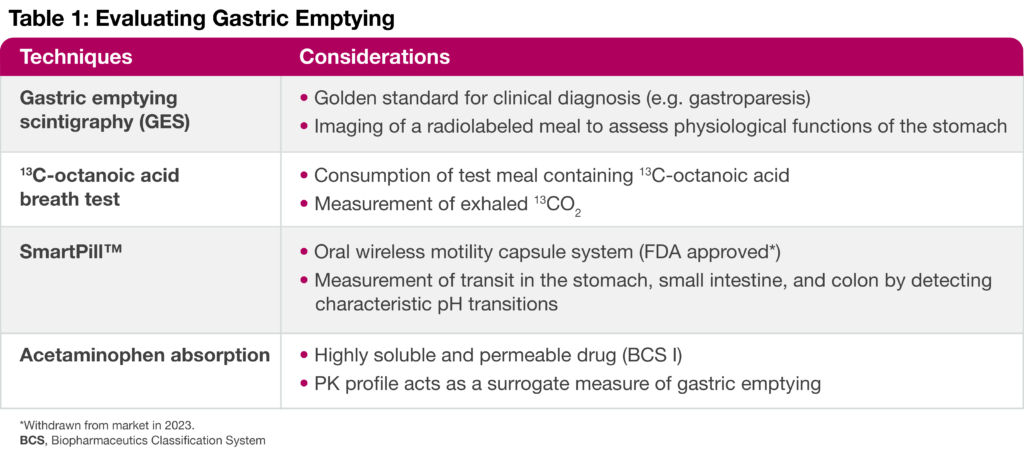
There are several techniques to assess gastric emptying in a clinical setting (Table 1). While scintigraphy is considered the gold standard for diagnostic purposes (e.g. for gastroparesis), an acetaminophen absorption assay applies classic pharmacology study designs to evaluate the role of gastric emptying in a drug-drug interaction study. In addition, the acetaminophen assay could be considered as a better predictor of drug absorption than the other approaches. In this assay, healthy volunteers consume acetaminophen dissolved in yogurt after administration of either a single dose or multiple doses (steady-state) of a drug that putatively alters gastric emptying. Then, changes in the acetaminophen PK profile are compared to a baseline or placebo condition.
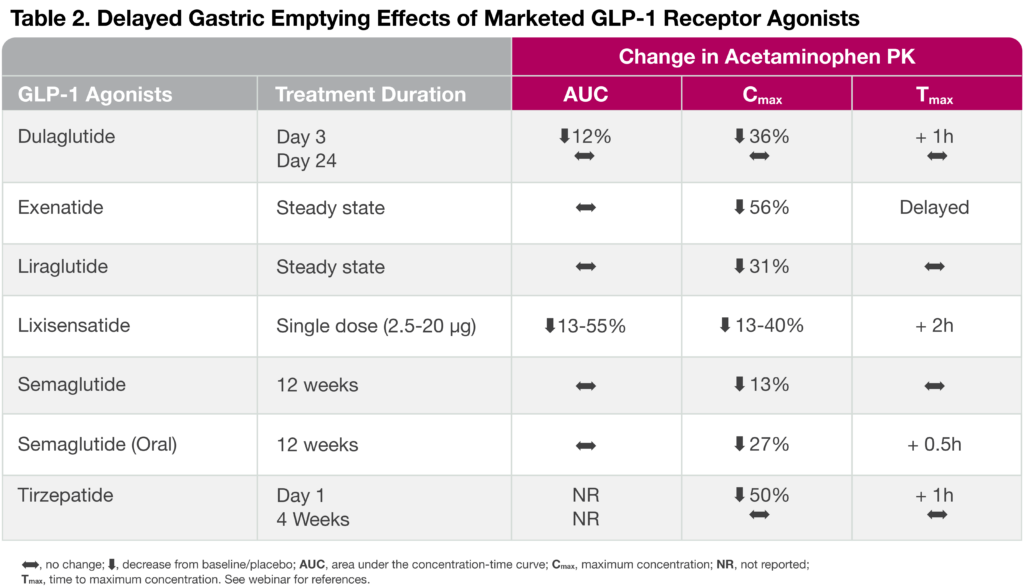
When gauging acetaminophen absorption effects across various marketed GLP-1 receptor agonists, the overall acetaminophen maximum plasma concentration (Cmax) was reduced by 13-56%, a hallmark of delayed gastric emptying (Table 2). Interestingly, the GLP-1 receptor agonist, dulaglutide, and the dual GLP-1 and GIP receptor agonist, tirzepatide, are both characterized by a strong delayed gastric emptying upon a single dose administration, but the effect tends to subside as gastric emptying tachyphylaxis is observed after several weeks of treatment. Nonetheless, the tirzepatide effect of delayed gastric emptying was found to significantly reduce oral contraceptive PK by ~ 60% and, thus, the drug label advises patients using oral hormonal contraceptives to switch to or add a non-oral contraceptive method when initiating tirzepatide and after each dose escalation.
Biopharmaceutics Classification System (BCS) and Delayed Gastric Emptying
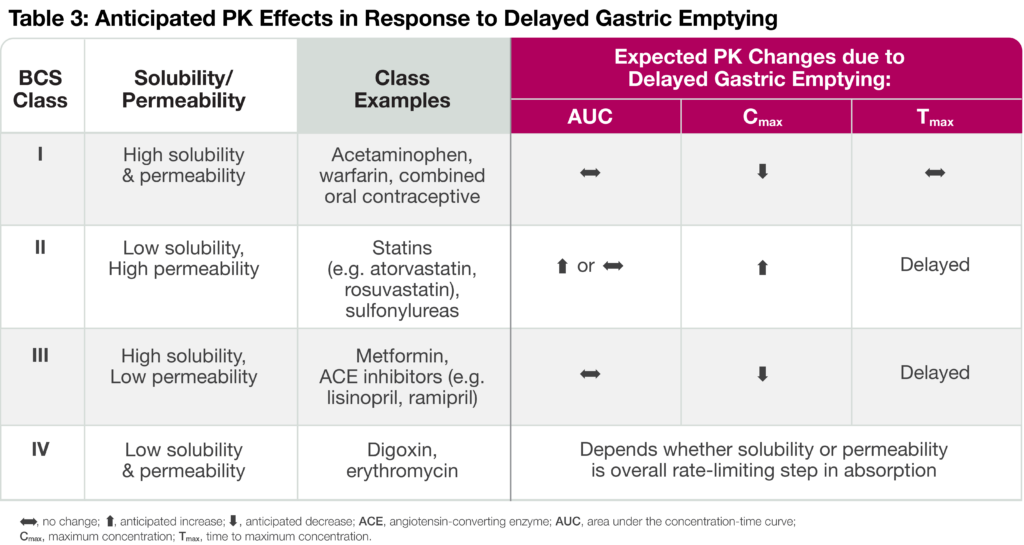
The rate of drug absorption depends on the solubility and permeability of an orally administered product. Solubility refers to the dissolution of the drug in an aqueous media, whereas permeability is the ability of a drug to cross membrane barriers and enter into the bloodstream. Oral small molecules, therefore, fall into one of four BCS categories depending on their solubility and permeability characteristics (Table 3). Delayed gastric emptying and reduced gastrointestinal (GI) motility can have different effects on drug PK dependent upon the drug’s BCS category. For instance, Class I drugs like acetaminophen display reduced Cmax in response to delayed gastric emptying. On the other hand, increased residence in the stomach leads to a higher degree of dissolved drug available for absorption immediately after entering the small intestine, resulting in increased PK exposure and delayed time to maximum concentration (Tmax) for Class II drugs. Reduced Cmax and delayed Tmax are anticipated for Class III drugs since intestinal permeability is rate-limiting. Finally, the anticipated PK changes due to delayed gastric emptying depend on whether solubility or permeability is the overall rate-limiting step in absorption.
A clinically relevant effect will depend on the extent of PK changes and the therapeutic index of the co-administered oral drug. For instance, while many of the GLP-1 drug interactions investigated to date may be ‘statistically significant,’ no dose adjustment is required because they were not found to be ‘clinically relevant.’ The one exception is tirzepatide, as described above. Nonetheless, for new GLP-1 drugs in development, it is imperative to evaluate potential drug interactions since this drug class can alter the efficacy of concomitant medications or increase the risk of adverse events as a result of higher exposure to a co-administrated drug.
Conclusion
GLP-1 receptor agonists have been known for their potential to delay gastric emptying. Consequent changes in AUC, Cmax, and Tmax values of orally administered concomitant medications may occur, which could impact drug efficacy or safety. Therefore, if a new oral drug in development is intended to be co-administered with a GLP-1 agonist, we highly recommend conducting a healthy volunteer drug-drug interaction prior to Phase 3 trials to characterize the impact on the PK of the candidate new drug. Similarly, novel GLP-1 receptor agonist-drug interaction studies evaluating the effect of delayed gastric emptying on the PK of oral medications from each BCS class should be considered.