
Sabina Paglialunga, PhD & Aernout van Haarst, PhD, Senior Directors, Scientific Affairs, Celerion
Clinical drug–drug interaction (DDI) programs during early drug development are often built around cytochrome P450 (CYP) enzymes and focus on phase I metabolism, but phase II metabolism can be just as consequential for patients. Phase II metabolism involves the conjugation of endogenous substrates, food compounds and drugs etc. with a polar moiety (for example, glucuronic acid, sulfate, or glutathione), making it more water-soluble for excretion. Enzymatic glucuronidation is the most common phase II conjugation pathway for many small molecule drugs and relies on UDP‑glucuronosyltransferases (UGTs).
There are 22 human UGTs, of which UGT1 and UGT2 superfamilies have been associated with DDIs. UGTs are highly expressed in “detoxification” organs such as liver, kidney, and intestine. They transfer glucuronic acid (GlcA) to lipophilic substrates to form hydrophilic glucuronides—often reducing biological activity, increasing solubility and enabling elimination via bile and urine.
Figure 1. Illustration of phase I and phase II Drug Metabolism Steps in the Liver
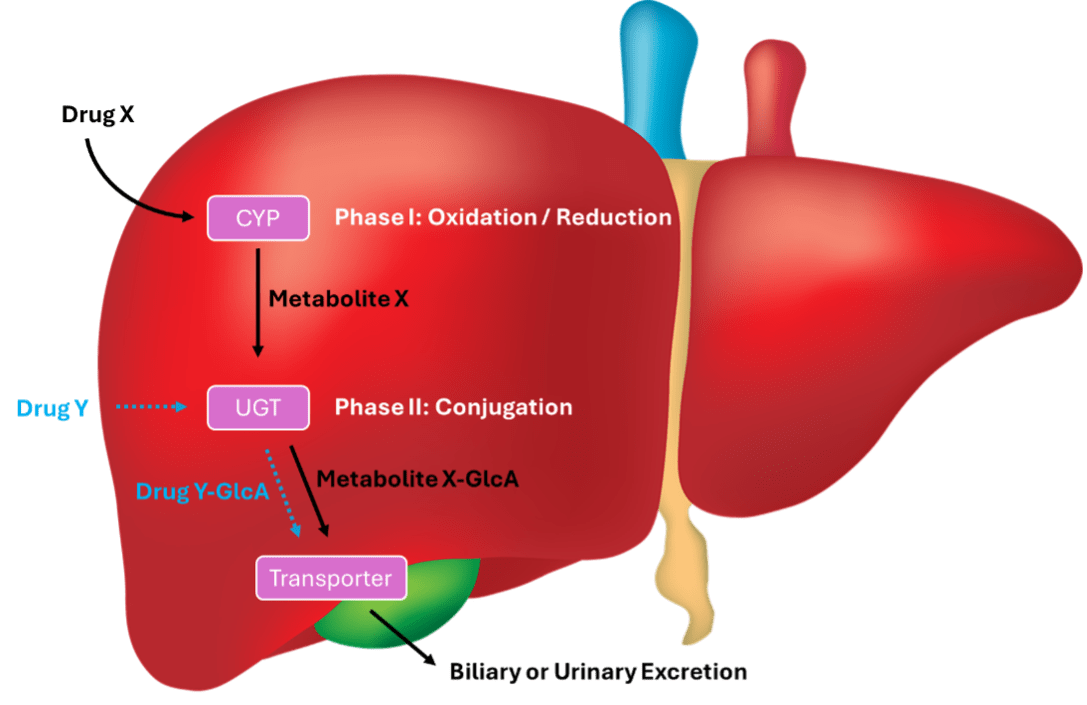
Simplified example of a medication Drug X that undergoes both Phase I and Phase II metabolic processes. Conversely, certain drugs like Drug Y can be directly glucuronidated in the liver without going through both phases.
A review of the 100 most prescribed medications found that ~20% of these drugs undergo phase II metabolism. While phase II metabolism is applicable for a relatively small portion of drugs, UGT inhibition or induction can shift drug exposure enough to influence efficacy, tolerability, and risk management decisions when an (investigational) drug (or a common concomitant medication) depends heavily on glucuronidation. In some settings, UGT liability intersects with clinically meaningful endpoints such as hyperbilirubinemia, drug‑induced liver injury (DILI), dose‑limiting toxicities in oncology as well as anticancer drug resistance.
When should you run a UGT DDI trial?
ICH M12 recognizes that, given the generally limited magnitude of UGT inhibition–mediated DDIs, routine clinical evaluation is not always warranted. Instead, the guideline encourages a risk-based approach that considers how much the investigational drug relies on glucuronidation, how sensitive the clinical setting is to exposure changes, and how likely relevant co‑medications are in the intended population.
- Direct Glucuronidation: If a major clearance pathway for the investigational drug (or a major active metabolite) is direct glucuronidation, UGT‑focused DDI risk becomes more clinically relevant.
- Narrow Therapeutic Window: This may be an important consideration if there is an exposure–toxicity concern related to phase II metabolism.
- Co‑Medication Risk: If the investigational drug will likely be co‑administered with drugs that are mainly metabolized by glucuronidation or with known UGT inhibitors/inducers, targeted in vitro evaluation should be considered and (when warranted) a clinical DDI study.
- Synergistic Induction: UGT enzymes can be induced by xenobiotic receptors (e.g., via PXR agonists, including several moderate/strong CYP3A inducers). When a study drug’s exposure is reduced by >50% when co-administered with a strong CYP3A inducer, it may be recommended to conduct a DDI trial with a UGT inducer. This becomes an important consideration when induction is plausible in the intended population and if exposure changes would be clinically meaningful.
From an in vitro perspective, ICH M12 highlights a set of UGTs that are commonly informative for drug development risk assessment (including UGT1A1, UGT1A4, UGT1A9, UGT2B7, and UGT2B15). If in vitro data and the overall risk assessment suggest potential clinical relevance, a clinical DDI evaluation can be designed around the most plausible interaction mechanism (inhibition vs induction vs substrate). For an inhibition role of a study drug it is important to consider the likelihood of its concomitant use with UGT substrates, as well as the safety profile of the interacting drug. The ICH M12 guidance provides a list of recommended UGT substrates, inhibitors and inducers for clinical studies.
Key Study Design Considerations for Clinical UGT DDIs:
- Measure parent and glucuronide metabolites to elucidate metabolic pathway. Quantifying glucuronide conjugates alongside parent drug concentrations can clarify whether an exposure change is driven by altered formation vs altered clearance and whether metabolites contribute to efficacy or safety (particularly when metabolites are active or reactive).
- Exposure magnitude: DDIs via UGT inhibition generally show less magnitude (measured by AUC ratio) compared to CYP inhibition. However, these may be clinically relevant depending on the patient population and risk of co-medication.
- Metabolite interference: Some drugs like gemfibrozil, form acidic glucuronides that can act as metabolism-dependent inhibitors of other enzymes, like CYP2C8.
- Use pharmacogenomics to bound risk. Functional variants in UGT enzymes (commonly discussed include UGT1A1 and several UGT2B genes) can shift pharmacokinetics and help estimate the range of exposure in the presence of inhibition/induction. In practice, inhibition effects may be most visible in individuals with lower baseline UGT activity.
Getting UGT Right!
UGTs are increasingly recognized not only as a clearance pathway, but also as a lever that can shape exposure, safety, and treatment recommendations. Since, in some cases, UGT drug interactions can result in DILI concerns or hyperbilirubinemia, a clinical investigation in healthy volunteers can help determine the risk. The goal is not to run “every possible” UGT DDI study—it’s to run the right study at the right time, guided by clearance pathways, exposure–response, and real‑world concomitant medication use. That said, Celerion has conducted more than 450 DDI studies, our experienced team of Protocol Writers and Scientists can advise on the right UGT DDI study design to meet your program needs.
Selected references
- International Council for Harmonisation (ICH). Drug Interaction Studies M12. Final guideline adopted 21 May 2024.
- Iversen DB et al. Drug metabolism and drug transport of the 100 most prescribed oral drugs. Basic Clin Pharmacol Toxicol. 2022; 131:311–324.
- Williams JA et al. Drug–drug interactions for UDP‑glucuronosyltransferase substrates: a pharmacokinetic explanation for typically observed low exposure (AUCi/AUC) ratios. Drug Metabolism and Disposition. 2004; 32(11):1201-8
- Meech R et al. The UDP-Glycosyltransferase (UGT) Superfamily: New Members, New Functions, and Novel Paradigms. Physiological Reviews 2019, 99:2, 1153-1222
- Shah MB. Inhibition of CYP2C8 by acyl glucuronides of gemfibrozil and clopidogrel: pharmacological significance, progress and challenges. Biomolecules. 2022; 2(9):1218